
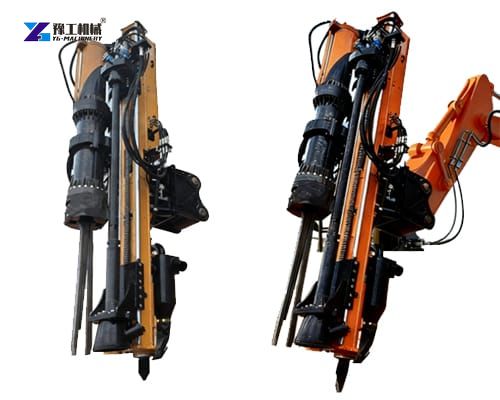
Excavator rock drill and splitter is a multifunctional attachment system. It is engineered to leverage the hydraulic power and mobility of an excavator. It operates in a two-stage process: first, a high-speed hydraulic rock drill creates a series of precisely spaced holes; second, a massive hydraulic splitter is inserted into these holes to apply lateral force, exceeding the tensile strength of the rock and causing it to fracture cleanly. This synergy allows for a continuous workflow. There is no need for separate machines or manual labor to move between the drilling and splitting phases. The operator controls the entire process from the safety of the cabin, making it one of the most efficient methods for secondary breaking and trenching in hard rock.
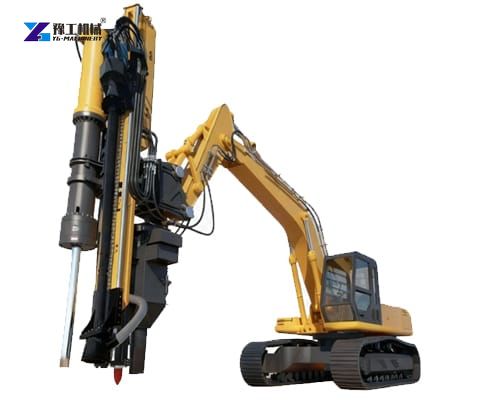
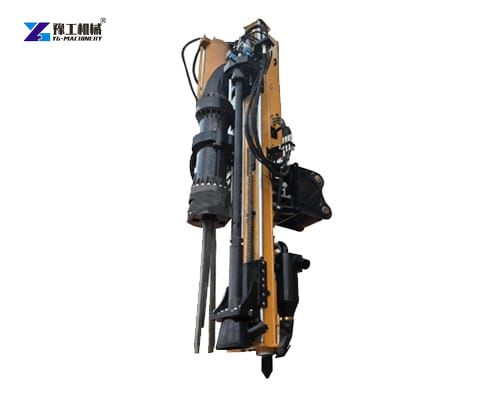
Integrated Rock Drill and Splitter Parameters
| Model | YG-130 |
| Suitable Excavator | 20T-36T Excavator |
| Maximum Horizontal Splitting Height | 9475mm |
| Maximum Vertical Splitting Height | 6715mm |
| Maximum Splitting Depth | 6705mm |
| Maximum Splitting Distance | 10225mm |
| Pilling Beam Length | 3875mm |
| Drilling Advance Stroke | 2000mm |
| Maximum Drilling Thrust Force | 50KN |
| Maximum Drilling Pull Force | 32KN |
| Piling Advance Stroke | 1500mm |
| Maximum Piling Thrust Force | 160KN |
| Maximum Piling Full Force | 100KN |
| Hydraulic Pressure | Max. 35Mpa |
| Hydraulic Flow | Min. 240L/min |
| Weight | 4200kg |
| Dimensions | 4210*1400*1785mm |
| Operation Mode | Remote Control |
Features and Technical Characteristics
The modern excavator rock drill and splitter is characterized by several key features that distinguish it from traditional hydraulic hammers or peckers.
- High Precision Control
Unlike a hydraulic breaker, which uses repetitive impact, the splitter uses static pressure. This allows for surgical precision. You can control the direction of the crack, which is vital when working near existing foundations or utility lines. - Extreme Splitting Force
These units are capable of generating thousands of tons of splitting force. While the hydraulic system of the excavator provides the input, the internal wedge mechanism of the splitter amplifies this force to overcome even the hardest granite or basalt. - Noise and Vibration Suppression
One of the most significant features is the near total absence of vibration and high-frequency noise. This makes the equipment ideal for indoor demolition, hospital expansions, or nighttime urban construction where noise ordinances are strict. - Robust Construction
Designed for the harshest environments, the components are typically made from high-strength alloy steels and treated with specialized coatings to resist wear and heat generated during the drilling process.
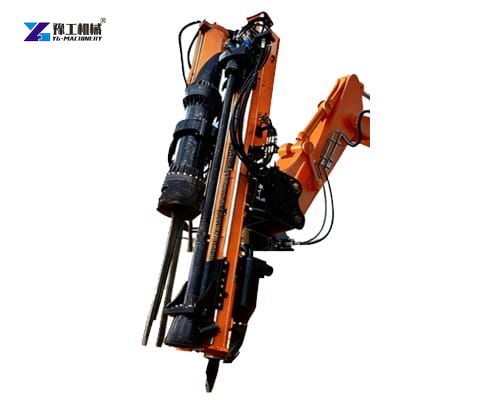
Main Applications and Uses
- In mining operations, it is commonly used for secondary breaking, block extraction, and selective mining where precision is essential. It helps reduce ore dilution and improves material recovery rates.
- In construction projects, the system is ideal for foundation excavation, basement construction, and road cutting. It allows controlled rock removal without damaging nearby structures.
- In quarrying, the excavator rock drill and splitter is used for dimension stone extraction. It enables clean splitting of stone blocks, preserving material quality and reducing waste.
- Tunnel and underground engineering projects also benefit greatly from this equipment. The low vibration characteristics help maintain tunnel stability and protect existing support structures.
- Additionally, it is frequently used in demolition work, particularly for breaking reinforced concrete structures where controlled cracking is required.
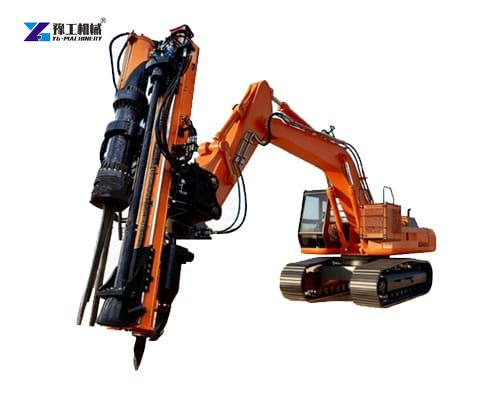
Excavator Rock Drill and Splitter Working Principle
The physics behind the integrated rock drill and splitter is based on the principle of tensile strength. Most rock has a very high compressive strength but a relatively low tensile strength.
- Step 1: Drilling
The excavator positions the drill head. The hydraulic drifter uses a combination of rotation and percussion to penetrate the rock. The holes must be drilled to a specific depth and diameter, calculated based on the rock type and the size of the splitter wedges. - Step 2: Positioning
Once the holes are prepared, the operator rotates the attachment to align the splitter with the first hole. The excavator’s arm provides the downward force to seat the wedges properly. - Step 3: Splitting
The hydraulic cylinder pushes the center wedge between the two counter wedges. As the center wedge moves down, it forces the counter wedges outward against the walls of the hole. This creates immense lateral tension. Within seconds, the rock reaches its breaking point and a crack propagates through the material. - Step 4: Removal
After the split is complete, the rock is fractured into manageable chunks that can be easily removed by a standard bucket or loaded into a hauler.
Structural Composition and Main Components
Understanding the structure of the excavator rock drill and splitter helps explain its efficiency and reliability.
- The hydraulic rock drill is the first major component. It consists of a drill body, impact piston, drill rod, and drill bit. Powered by the excavator hydraulic system, it delivers high frequency impact energy to penetrate hard rock.
- The hydraulic splitter is the second core component. It typically includes a wedge or piston assembly housed in a robust steel body. When hydraulic pressure is applied, the splitter expands, generating immense lateral force within the drilled hole.
- The hydraulic control system connects both components to the excavator. It includes hoses, valves, and control levers that allow the operator to switch between drilling and splitting functions seamlessly.
- Mounting brackets and adapters ensure secure attachment to different excavator models. These are designed to withstand high stress and provide stability during operation.
The Importance of the Excavator Rock Drill and Splitter
The construction and mining industries have long grappled with the challenges of hard rock excavation. This integrated technology combines the precision of hydraulic drilling with the immense power of hydraulic splitting, mounted directly onto a standard excavator. By transforming a versatile carrier into a specialized rock-breaking powerhouse, contractors can now handle projects in urban areas, sensitive environments, and high-precision sites where explosives are strictly prohibited.