
Choosing a suitable integrated rock drill and splitter can save time, money, and headaches on the job site. Here are some tips on how to choose the integrated rock drill and splitter for your excavator. Hoping this article can help you to select a suitable type.
Consider These Questions Before You Start
- What is the mass and power of your excavator? The available hydraulic flow, pressure, and lifting capacity determine what rock drill and splitter you can run efficiently.
- What tasks will you perform most often? Quarrying, trenching, road work, or slope stabilization each has different drill bits, pressure, and rotation requirements.
- What rock types will you encounter? Hard, abrasive rock (like quartzite or granite) vs. softer, fractured rock will influence the choice of drill bits, hammering rate, and the splitter’s stroke force.
- What is your production target? If you need high daily output, a robust, high-cycle unit with good automation may pay off even if it costs more upfront.
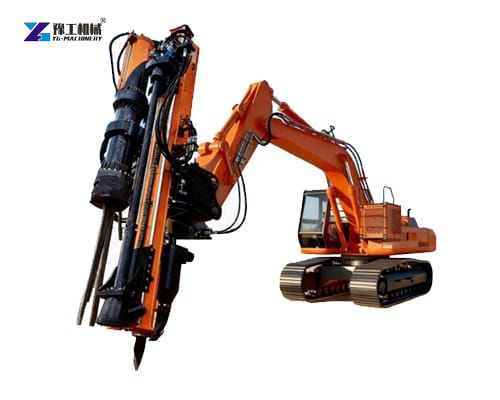
Integrated Rock Drill and Splitter for Sale in YG Attachments
There are three models for different types of excavators: YG-130 for 20T-36T excavators, YG-152 for 36T-48T excavators, and YG-210 for 48T-65T excavators. We can choose the suitable one according to our needs. For specific brand excavators, please confirm with us.
| Model | YG-130 | YG-152 | YG-210 |
| Suitable Excavator | 20T-36T Excavator | 36T-48T Excavator | 48T-65T Excavator |
| Maximum Horizontal Splitting Height | 9475mm | 9985mm | 10680mm |
| Maximum Vertical Splitting Height | 6715mm | 6905mm | 6770mm |
| Maximum Splitting Depth | 6705mm | 7025mm | 8050mm |
| Maximum Splitting Distance | 10225mm | 10875mm | 11640mm |
| Pilling Beam Length | 3875mm | 4850mm | 5525mm |
| Drilling Advance Stroke | 2000mm | 2600mm | 3500mm |
| Maximum Drilling Thrust Force | 50KN | 50KN | 50KN |
| Maximum Drilling Pull Force | 32KN | 32KN | 32KN |
| Piling Advance Stroke | 1500mm | 1800mm | 2300mm |
| Maximum Piling Thrust Force | 160KN | 160KN | 160KN |
| Maximum Piling Full Force | 100KN | 100KN | 100KN |
| Hydraulic Pressure | Max. 35Mpa | Max. 35Mpa | Max. 35Mpa |
| Hydraulic Flow | Min. 240L/min | Min. 240L/min | Min. 240L/min |
| Weight | 4200kg | 6200kg | 8300kg |
| Dimensions | 4210*1400*1785mm | 5270*1485*1840mm | 5810*1485*1840mm |
| Operation Mode | Remote Control | Remote Control | Remote Control |
Performance Specs to Compare
- Hydraulic flow and pressure compatibility: Check your excavator’s hydraulic pump rating and ensure the integrated unit matches or operates efficiently within that window. Mismatches can reduce performance or damage the system.
- Impact energy and rotation: For drilling, consider the impact energy and RPM range. For splitting, look at the ram force, stroke length, and repeatability.
- Bit compatibility and feed system: Verify what drill bit sizes are supported and whether the splitter has a compatible hydraulic system to push the rock without binding.
- Weight and counterweight considerations: Ensure the combination stays within the excavator’s lift capacity and counterweight limits to avoid tipping or undue wear.
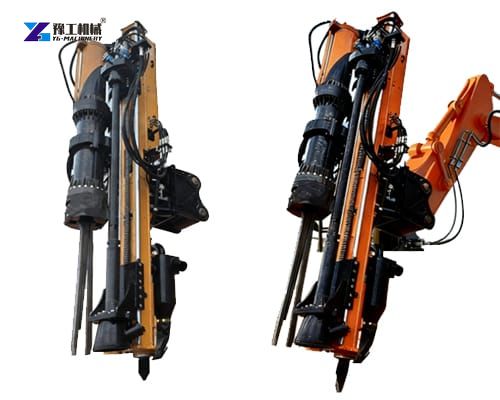
Operating Considerations for Best Results
- Proper setup: Ensure the unit is correctly clamped, aligned, and that the hydraulic connections are tight and clean. Misalignment can cause accelerated wear or inefficient drilling.
- Drill bits and wear parts: Choose high-quality bits designed for your rock type. Keep spare bits and splitters’ jaws on hand, and replace worn parts before they fail during a job.
- Lubrication and cooling: Adequate lubrication and cooling on the drill’s hammer mechanism and splitter ram reduce heat buildup and maintenance costs. Follow manufacturer guidelines for intervals.
- Operator training: A skilled operator will maximize output and reduce damage. If you’re adopting a new integrated system, consider a training session on setup, operation, and troubleshooting.
- Routine inspection: Inspect hoses, seals, and linkages daily or per shift. Look for signs of wear, leaks, or misalignment and address them promptly.
If you are looking for the integrated rock drill and splitter, please contact us for more details and free quotation.