
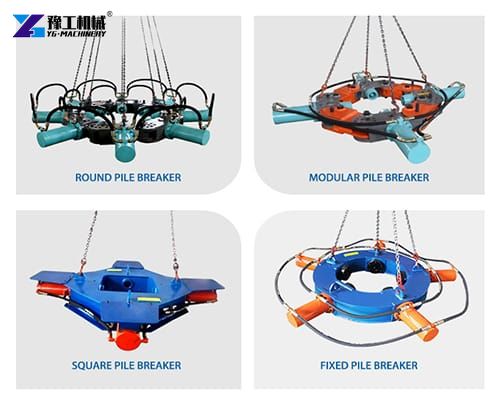
As the name implies, the round pile breaker is designed for round pile, while the square pile breaker is applied to handle the square piles. Round piles are perhaps the most common foundation elements used in large-scale infrastructure projects, such as bridges, high-rise buildings, and marine docks. The round pile breaker machine is a staple in the demolition industry. Square piles are frequently used in residential construction, industrial warehouses, and smaller-scale civil works where precast piles are preferred. People can choose the suitable round pile breaker and square pile breaker according to their real requirements.
Design and Mechanism of Round Pile Breaker and Square Pile Breaker
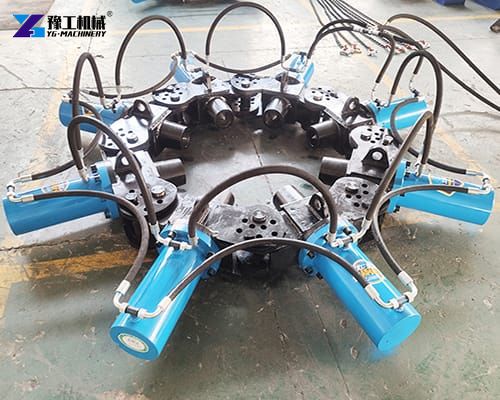
Round concrete pile breaker typically features a modular, ring-like design. It consists of several identical hydraulic cylinders connected by pins. This modularity is its greatest strength; by adding or removing links, the breaker can be adjusted to fit various pile diameters. When the hydraulic system is activated, the cylinders drive chisels simultaneously toward the center of the pile. This synchronized pressure creates a concentrated fracture line, snapping the concrete head while leaving the reinforcement intact.
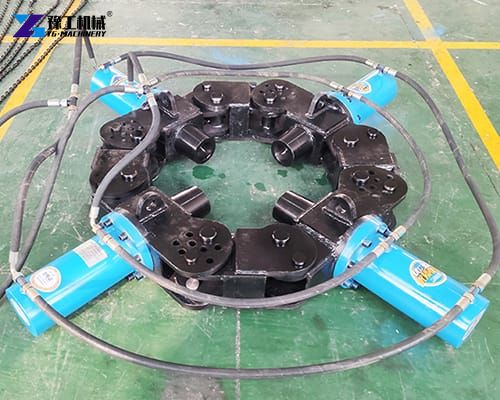
Square pile breaker machine is usually a fixed-frame or semi-adjustable unit designed to apply pressure at four key points. It aligns its chisels with the flat faces of the square pile. There are two types of concrete pile breakers for square piles. One is precast and reinforced with specific cage designs. One type adopts a modular design, connecting four hydraulic cylinders by pins.
Advantages of the Round & Square Pile Breaker Machine
| Advantages of Round Pile Breakers | Advantages of Square Pile Breakers |
| 1. Extreme Versatility: Because of the modular design, a single set of equipment can often handle piles ranging from 600mm to over 2000mm in diameter. 2. Uniform Pressure Distribution: The radial arrangement of the cylinders ensures that pressure is applied evenly from all sides, which minimizes the risk of the pile tilting or cracking unevenly. | 1. Precision in Precast Applications: Square breakers are optimized for the standard sizes of precast piles (e.g., 400mm x 400mm to 500mm x 500mm), providing a clean cut every time. 2. Compact Footprint: These units are often compact, making them ideal for urban jobsites where space is at a premium. |
Operational Best Practices for Pile Breaking
Regardless of whether you are using a round or square breaker, following these operational guidelines will ensure longevity of the equipment and safety on site.
- Pre-Operation Inspection
Before beginning the day, operators should check all hydraulic hoses for leaks and ensure that the pins connecting the modules (in round breakers) are secure. The chisels (points) should be inspected for bluntness. Dull chisels increase the stress on the hydraulic cylinders and lead to jagged cuts. - Positioning the Breaker
The breaker should be leveled before it is lowered onto the pile. If the breaker is tilted, the chisels will strike at an angle, which can cause the pile to crack diagonally or damage the rebar. Most modern breakers are suspended from the excavator via a chain or a specialized lifting frame to allow for self-leveling. - The Breaking Process
It is often more effective to break the pile in sections rather than trying to crush the pile head in one go. By “nibbling” away at the concrete, the operator reduces the strain on the machine and ensures a cleaner finish at the final cut-off level.
No matter the round concrete piles or square piles, we provide both breaking solutions. For more detailed information, please get in touch with us. 【WhatsApp/WeChat: +86 18337123872 Email: admin@ygattachments.com】