
Hydraulic concrete pile breaker is a high-efficiency demolition device designed to cut and remove reinforced concrete piles. After the piles are driven or cast in place, the upper section often needs to be removed to the required elevation before the superstructure can be built. It operates by utilizing high-pressure hydraulic power to apply concentrated, controlled force, causing the concrete to fracture along predetermined lines. This tool performs a surgical break, leaving a clean, vertical finish that often requires no further processing. It is designed to minimize environmental impact, reduce labor costs, enhance worker safety, and accelerate project timelines. It has become essential in high-rise construction, bridge foundations, port engineering, highway projects, and other applications where large quantities of piles must be processed.
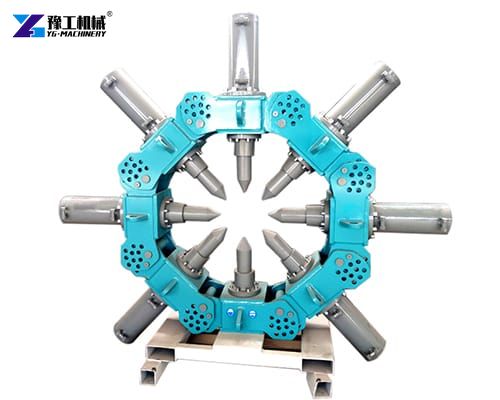
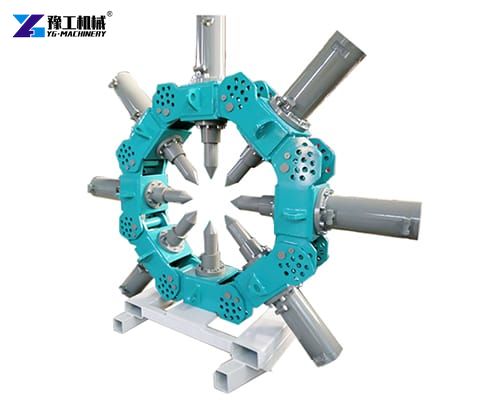
Features of Hydraulic Pile Breakers
- Robust modular design that can be adjusted according to pile diameter
- Uniform and synchronous crushing force derived from hydraulic cylinders
- High breaking efficiency across both cast-in-place and precast piles
- Precision in retaining steel reinforcement bars undamaged
- Hydraulic concrete pile breaker has the features of low noise and reduced vibration to protect nearby structures
- Compatibility with a wide variety of excavators, cranes, or power units
- Long service life thanks to heavy-duty alloy components
- Ease of transport and flexible assembly for diverse jobsite conditions
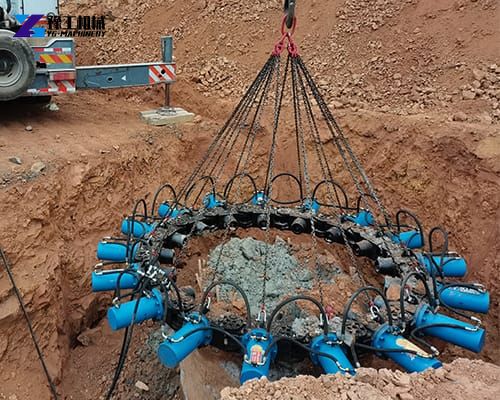
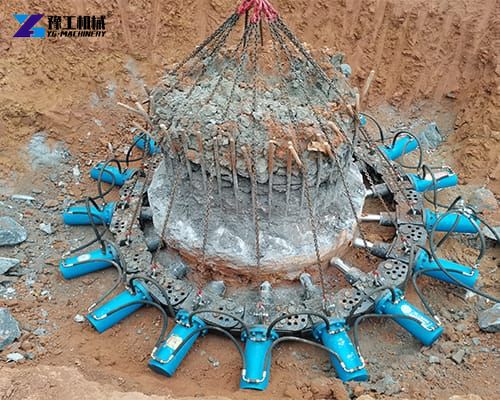
Structural Components of Concrete Pile Breaker
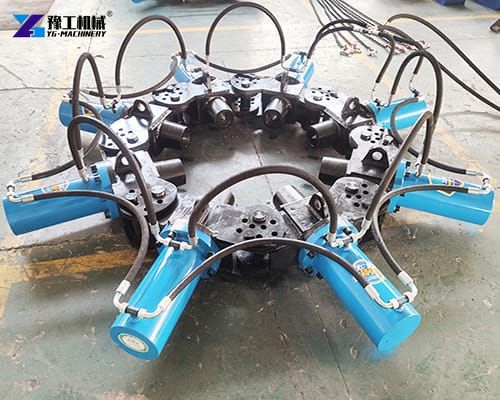
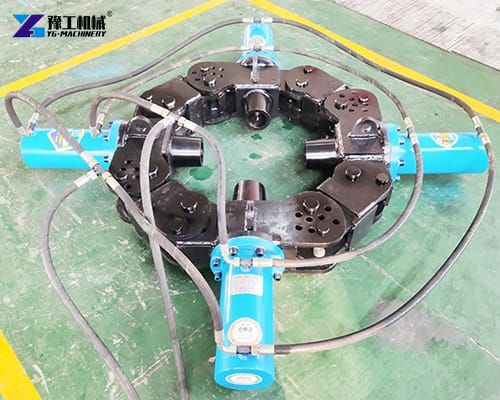
- Hydraulic cylinders
These are the power-generating units. They apply synchronized force on the pile surface, causing controlled cracking. - Breaker modules
Each module contains a hydraulic cylinder, a frame, and crushing tools. Multiple modules are linked to encircle the pile. - Crushing teeth
These hardened alloy teeth transmit the hydraulic force directly into the concrete, creating fracture lines. - Connecting brackets
Used to adjust the module arrangement for different pile shapes and sizes. - Hydraulic hoses and manifolds
Hydraulic concrete pile breaker carry pressurized fluid to each cylinder, ensuring synchronized output. - Control system
Operators use a control valve or integrated console to initiate and stop the breaking action. - Lifting device interface
The pile breaker is usually mounted on an excavator, crane, or other carrier through a standardized connection point.
Wide Applications of the Excavator Pile Breaker
Because of its scalability and adaptability, the hydraulic concrete pile breaker is used in many fields:
Urban building foundations where a wide range of pile diameters are encountered
Bridge and flyover projects requiring extensive deep pile foundations
Railway and highway construction in terrains where fast foundation work is essential
Coastal engineering, including ports, wharves, and offshore platforms
Dams and water conservancy systems that involve large-scale pile installations
Industrial facilities and warehouses requiring stable load transfer systems
Advantages Compared To Traditional Methods
The adoption of hydraulic concrete pile breakers mainly results from the many advantages they offer.
- Greater efficiency
A hydraulic pile breaker can remove the pile head in minutes instead of hours. This reduces overall project duration and labor costs significantly. - Higher precision
Traditional striking methods often cause irregular pile heads or crack propagation along the pile body. A hydraulic concrete pile breaker creates a smooth, controllable break line. - Improved safety
Since the machine handles most of the heavy work, manual involvement is minimized. - Reduced noise and vibration
Mechanical striking generates significant impact forces. Hydraulic pressure, however, breaks the concrete steadily, leading to a quieter and more environmentally friendly process. - Lower cost over time
Although the initial investment is higher, the long term savings in labor, repair, and rework make hydraulic pile breakers more cost effective. - Better protection of reinforcement
This tool preserves the steel bars, which are often required for further structural integration. - Scalability
By adjusting the number of modules, a single system can handle multiple pile diameters.
Excavator Concrete Pile BreakerWorking Principle
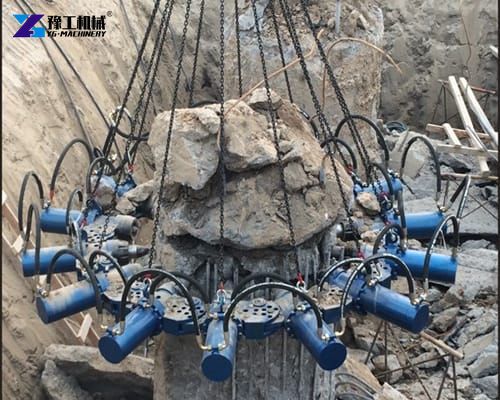
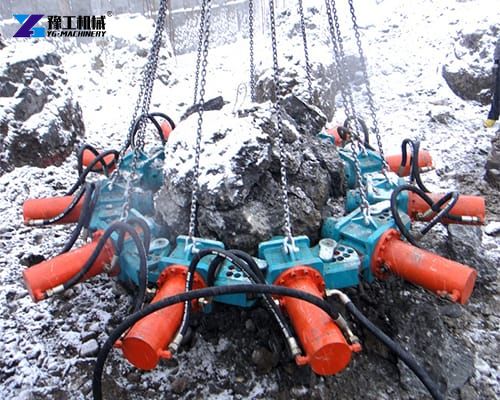
The working principle of a hydraulic concrete pile breaker is based on uniform radial pressure. The process can be summarized in several steps:
- The pile breaker modules are arranged around the pile head according to the pile diameter.
- Once the system is secured and aligned, the hydraulic pump begins sending pressure to each cylinder.
- The crushing teeth move inward, applying even force from all sides. This prevents directional stress concentrations.
- As the pressure increases, microcracks form on the pile surface. These cracks propagate until the concrete fails along the predetermined height.
- Rebar remains intact because the crushing force targets the brittle concrete rather than the ductile steel.
- After the concrete detaches, the machine lifts away the broken top section.
Tips for Choosing the Right Hydraulic Concrete Pile Breaker
Selecting the right equipment is essential for efficiency and cost savings. Consider the following points:
- Confirm the required pile diameter range
Modular breakers can be adjusted, but each model has limitations. Make sure the configuration fits your pile specifications. - Check compatibility with your carrier
The excavator or crane must provide adequate hydraulic flow and lifting capacity. - Evaluate the number and strength of cylinders
More cylinders mean greater breaking force and improved control.