
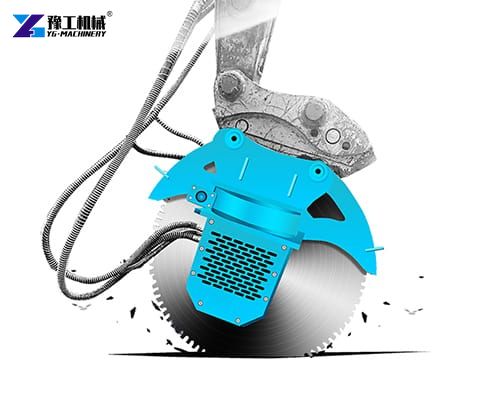
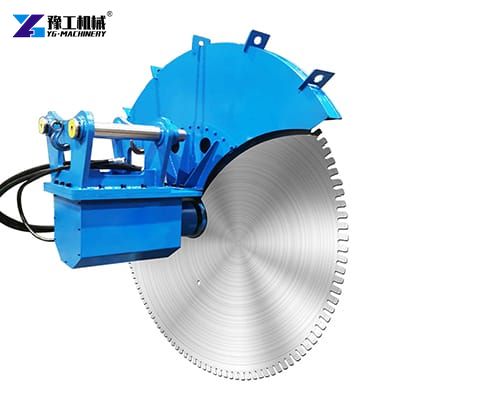
Rock saw attachment for excavator, often referred to as an excavator-mounted saw or rotary cutter, is a high-powered, durable cutting wheel designed to be affixed to the boom or stick of a standard hydraulic excavator. Different from hydraulic breakers or rippers that fracture material through impact or force, the rock saw utilizes a continuous rotation of a diamond or carbide-tipped blade to precisely cut through extremely tough substrates.
Excavator Rock Saw Attachment Parameters
| Model | YG-J1 | YG-J2 | YG-J3 | YG-Q1 | YG-Q2 |
| Suitable excavator type | 2-4T | 6-9T | 10-18T | 20-28T | 30-45T |
| Circular saw diameter | 0.4-0.8m | 1.2-1.6m | 1.8-2.2m | 2.2-2.6mm | 2.6-3.2mm |
| Cutting slit width | 5mm | 9mm | 14mm | 30mm | 30mm |
| Max. Cutting depth | ≤250mm | ≤600mm | ≤900mm | ≤1100mm | ≤1400mm |
| Rated pressure | 30Mpa | 30Mpa | 30Mpa | 35Mpa | 35Mpa |
| Recommended flow | 30L/min | 80L/min | 120L/min | 220L/min | 300L/min |
Main Components of Rock Saw Attachment for Excavator
The fundamental design of a rock saw attachment for an excavator centers on a few critical components:
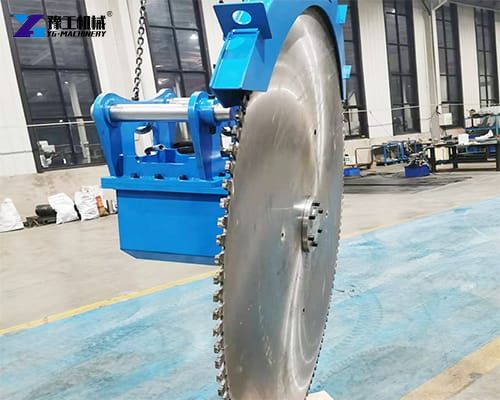
- The Cutting Wheel: This is the core of the attachment. Blades are typically made from hardened steel and embedded with diamond segments or durable carbide teeth. Diamond blades are preferred for the hardest materials, offering superior cutting speed and lifespan, while carbide-tipped blades are suitable for softer rock, asphalt, and concrete. The diameter of the blade dictates the maximum cutting depth.
- The Hydraulic Motor: Powering the massive cutting wheel is a robust hydraulic motor, designed to withstand intense pressure and deliver consistent, high torque rotation. The motor’s performance must be perfectly matched to the excavator’s hydraulic flow and pressure capabilities.
- The Mounting Bracket: This component ensures a secure, quick, and stable connection to the excavator’s quick coupler or pin-on system. It must be engineered for maximum structural integrity to handle the significant cutting forces and vibrations.
- The Drive System: This transfers the torque from the hydraulic motor to the cutting wheel. It is often gear-driven or direct-drive, engineered for minimal energy loss and maximum reliability.

Applications In Diverse Industries
- Trenching And Utility Installation
One of the most common applications is for trenching in rocky or urban environments. When laying pipelines, fiber optic cables, or utility lines, traditional trenching often involves slow, costly blasting or the use of hydraulic hammers, which cause significant noise and ground vibration. - Clean, Vertical Walls: The rock saw cuts trenches with smooth, vertical walls, minimizing the amount of material that needs to be excavated and backfilled. This precision is impossible to achieve with a bucket or hammer.
- Urban Work: In densely populated areas, the lower vibration and noise signature of a saw compared to a breaker makes it the only viable option, preventing damage to nearby structures and reducing community disruption.
- Quarrying and Surface Mining
In quarry operations, the rock saw attachment for excavator is used for selective mining and dimension stone cutting. Besides, it allows for the precise cutting of valuable dimension stone blocks directly from the quarry face. The smooth, clean cuts minimize waste and maximize the value of the extra.

How Does A Rock Saw Attachment Work?
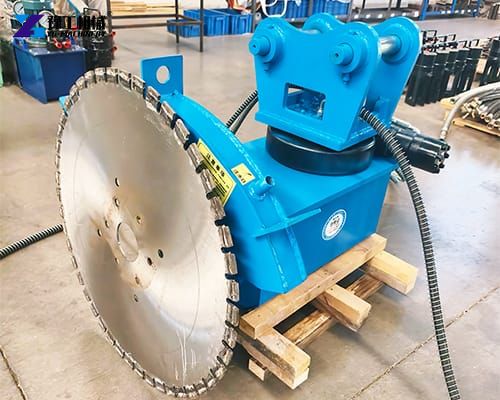
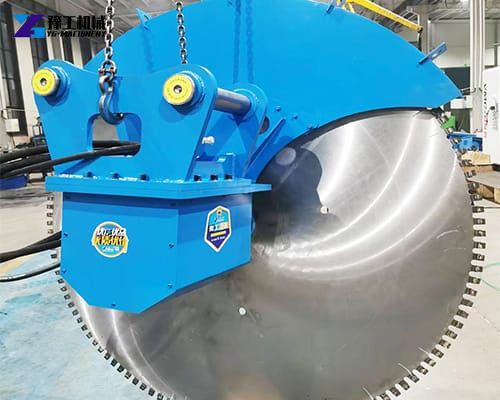
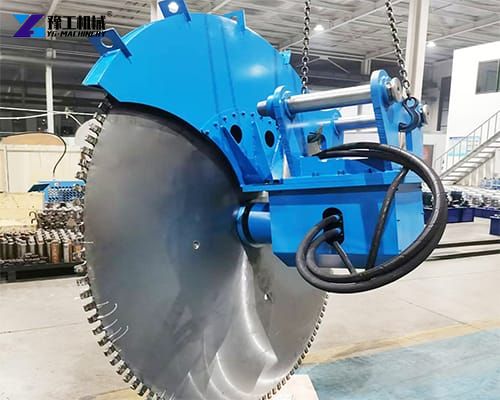
The operational mechanism of a rock saw attachment for excavator is based on a hydraulic motor system connected to the excavator’s hydraulic power. The motor drives the circular blade, which is usually equipped with diamond segments or carbide tips for enhanced cutting power. As the blade spins and applies consistent pressure to the material, the high-speed rotational force allows precise slicing through even the hardest substrates. Main components of a rock saw attachment include the hydraulic drive motor, mounting bracket, rotating blade, protective cover, bearing structure, and lubrication system.
Benefits of Using A Rock Saw for Excavator
High cutting precision
The attachment delivers clean, straight, and uniform cuts. This is particularly beneficial for trenching, creating foundation slots, preparing structural joints, and working in confined or sensitive areas where precision is essential.
Reduced vibration and noise
Unlike hydraulic breakers or blasting, the rock saw produces significantly lower vibration levels. This reduces structural impact risks and helps protect nearby buildings, underground utilities, or fragile geological formations.
Versatility across different materials
A rock saw attachment for excavator can cut through granite, limestone, sandstone, marble, reinforced concrete, asphalt, frozen ground, and other dense materials. By swapping blades, operators can easily adapt the tool for different project requirements.
Increased productivity
The cutting efficiency of a rock saw is much higher than manual cutting or traditional excavation methods. Operators can complete tasks faster while maintaining high accuracy and minimizing rework.
Factors to Look for in an Excavator Rock Saw Attachment
- Blade quality and material
Industrial diamond segments offer the highest performance in hard rock conditions. Blade durability directly affects cutting efficiency and cost. - Hydraulic compatibility
Ensure the rock saw attachment for excavator matches the excavator’s hydraulic pressure and flow rate for optimal performance. - Structural strength
A reinforced frame, high-quality bearings, and robust motor construction help the rock saw handle heavy workloads and rough terrain. - Cutting depth and diameter options
Choose blade sizes according to material hardness and required cutting depth.