Rock drill and splitter is not just a single tool but a synchronized system designed to break hard rock and concrete with surgical precision. The process involves two distinct stages. First, a high-powered drill creates a hole of a specific diameter and depth into the material. Second, a hydraulic splitter is inserted into that hole, applying immense internal pressure to force the rock apart along its natural tension lines. Different from an impact breaker that hits the surface repeatedly, the splitter works from the inside out. This fundamental difference in physics allows for the controlled demolition of massive boulders and bedrock.
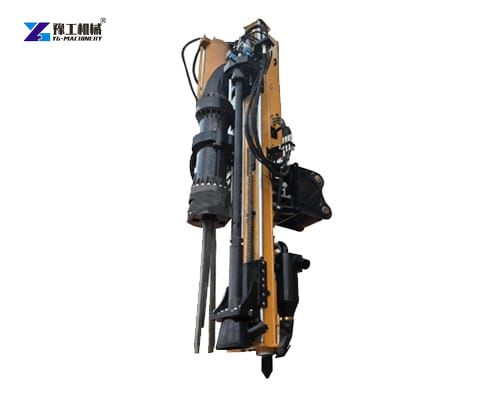
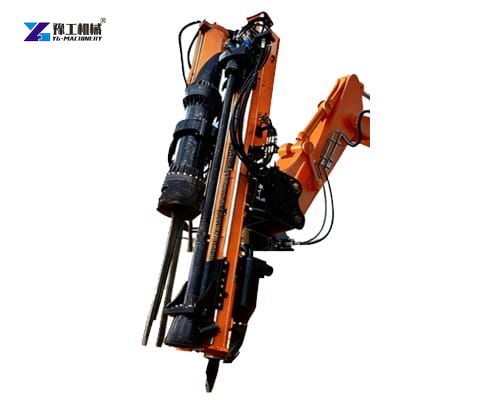
Hydraulic Rock Drill and Splitter Specifications
| Model | YG-130 |
| Suitable Excavator | 20T-36T Excavator |
| Maximum Horizontal Splitting Height | 9475mm |
| Maximum Vertical Splitting Height | 6715mm |
| Maximum Splitting Depth | 6705mm |
| Maximum Splitting Distance | 10225mm |
| Pilling Beam Length | 3875mm |
| Drilling Advance Stroke | 2000mm |
| Maximum Drilling Thrust Force | 50KN |
| Maximum Drilling Pull Force | 32KN |
| Piling Advance Stroke | 1500mm |
| Maximum Piling Thrust Force | 160KN |
| Maximum Piling Full Force | 100KN |
| Hydraulic Pressure | Max. 35Mpa |
| Hydraulic Flow | Min. 240L/min |
| Weight | 4200kg |
| Dimensions | 4210*1400*1785mm |
| Operation Mode | Remote Control |
Characteristics of High-Performance Rock Drill and Splitter
Non-Explosive Nature: It provides a powerful alternative to dynamite, making it ideal for projects where blasting is legally prohibited or physically dangerous.
Vibration-Free Operation: Because the rock is “pushed” apart rather than “beaten” or “blown” apart, the vibrations are negligible.
Dust Suppression: The slow, controlled splitting action generates significantly less airborne dust compared to pneumatic hammers, protecting the health of operators and the surrounding community.
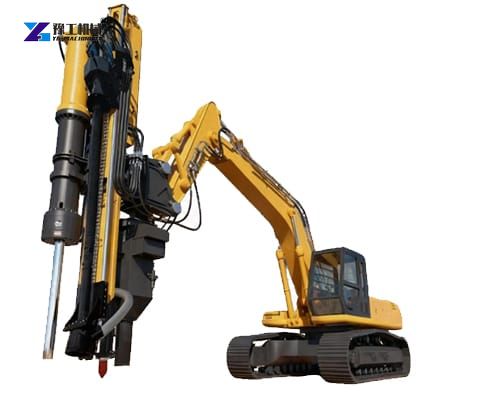
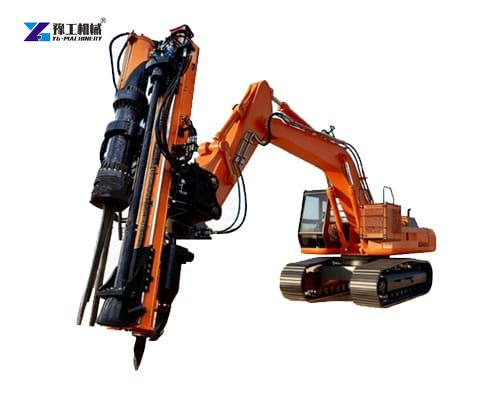
Technical Structure and Components
To understand how these rock drills and splitters survive the harsh environments they operate in, we must look at their structural composition.
- The Drill Mast
This is the backbone of the unit. It must be constructed from high-strength alloy steel to withstand the torque and feed force required to penetrate hard rock like basalt or quartz. - The Hydraulic Power Pack
The heart of the splitting action. It converts hydraulic flow from the carrier (excavator) into intensified pressure. - The Wedge Set
Consisting of a center wedge and two counter wedges (feathers), this is the component that enters the rock. These are usually coated with specialized lubricants or made from proprietary wear-resistant materials to reduce friction and prevent seizing. - The Rotation Motor
For the drilling phase, a high-torque motor ensures that the drill bit maintains consistent RPM even when encountering varying rock densities.
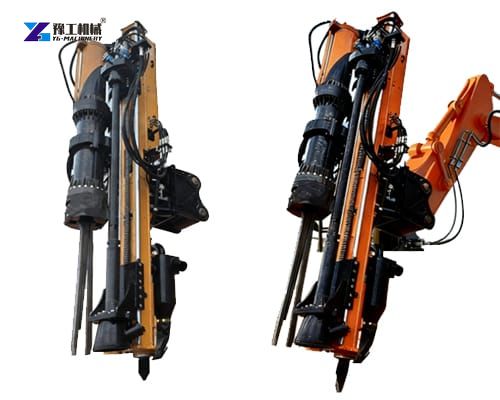
The Physics of Power: How It Works
The working principle of a rock drill and splitter is a masterclass in mechanical advantage.
Step 1: The Drilling Phase: The rock drill uses a combination of rotation and percussive force to create a cylindrical void. The diameter of this hole is crucial; it must be slightly larger than the collapsed splitter wedges to allow for easy insertion but tight enough to maximize the transfer of force.
Step 2: The Splitting Phase: Once the wedges are inserted, the hydraulic cylinder drives the center wedge forward. This forces the two counter wedges outward against the walls of the hole.
The Engineering Principle: Rock has very high compressive strength (it is hard to crush) but very low tensile strength (it is easy to pull apart). By applying outward pressure from within, the splitter exploits this natural weakness. Once the tensile strength of the rock is exceeded, a crack forms instantly and propagates through the mass.
How to Select the Right Rock Drill and Splitter Attachment
Choosing the right equipment requires a deep understanding of your specific project needs. Consider the following factors:
- Carrier Compatibility: Ensure the weight of the drill and splitter unit matches the lifting capacity and hydraulic flow of your excavator. An oversized unit will tip the machine, while an undersized one will be slow.
- Rock Type: Harder rocks like granite require higher splitting forces. Softer rocks like limestone may require wider wedge expansion to ensure the crack travels far enough.
- Hole Diameter and Depth: Deep holes allow for larger volumes of rock to be moved per split, but they require more powerful drills.