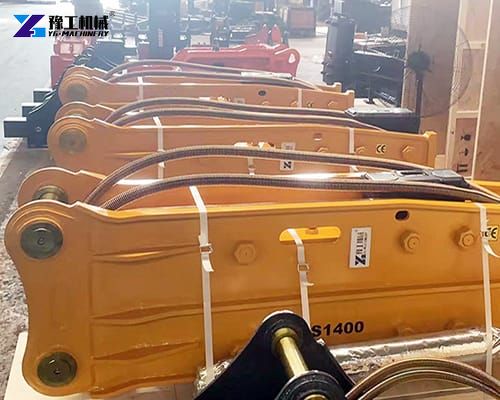
A customer’s company in New Zealand faced the challenging construction environments. The project involved excavation and reinforcement of rocky river channels in a remote mountainous region, where access was limited and geological conditions were extremely hard. The project engineering team began sourcing a breaker hammer for an excavator capable of operating continuously under high-load conditions. Durability, heat resistance, and hydraulic stability were identified as the important criteria. He found us when he was looking for the attachment online. We replied to him soon and confirmed his requirements. The YGB1600S excavator breaker hammer for a 20-ton excavator was recommended. After confirming the specifications and making some adjustments, the client placed the order.
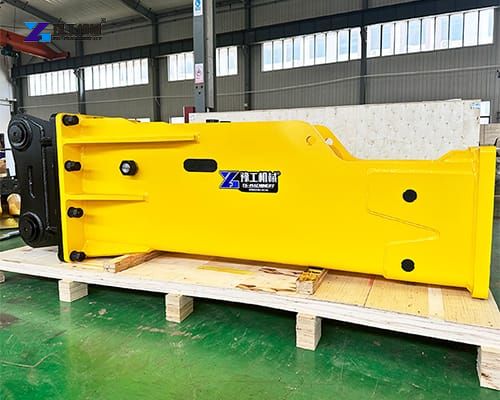
Parameters of Breaker Hammer for Excavator Sold to New Zealand
| Model | YGB1600S |
| Weight | 1600kg |
| Length | 2695mm |
| Pressure | 160-180bar |
| Flow | 120-160lpm |
| Rate | 400-700bmp |
| Hose | 1inch |
| Chisel | 135mm |
| Suit | 19-26ton |
Why Does a Breaker Hammer for Excavator Matter?
Efficiency on tough jobs: Concrete, rock, and asphalt crumble under the hammer’s impact, allowing you to clear or shape sites faster than traditional breakers.
Reduced operator fatigue: The excavator does the heavy lifting, while the breaker hammer for the excavator translates that power into controlled bursts, keeping fatigue to a minimum.
Reduce manual labor and site labor costs: Improve jobsite safety by reducing manual chisel work
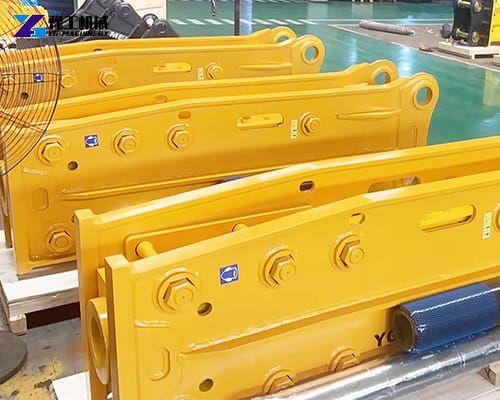
Choosing the right breaker hammer for an excavator?
Weight and class compatibility: Match the breaker to your excavator’s weight class and hydraulic flow. A mismatch can reduce impact energy, increase wear, and reduce efficiency.
Impact energy and rate: Higher impact energy speeds breakage but may demand more hydraulic power. Consider the job’s material hardness and desired cycle time.
Damping and vibration control: Modern hammers incorporate anti-vibration systems to protect the operator and extend tool life.
Maintenance and reliability: Look for robust seals, easy access grease points, and modular components that simplify field servicing.