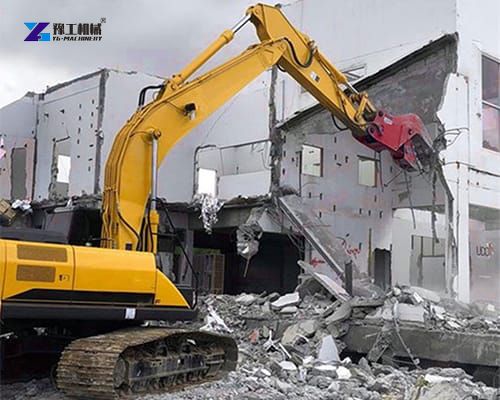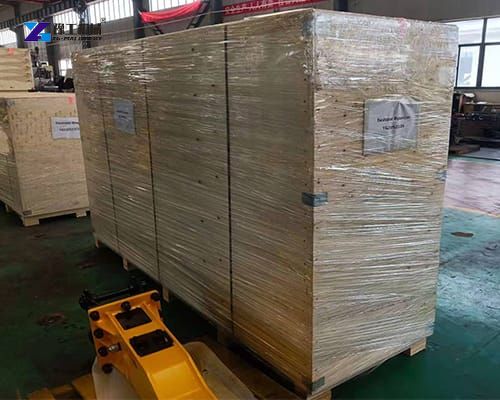
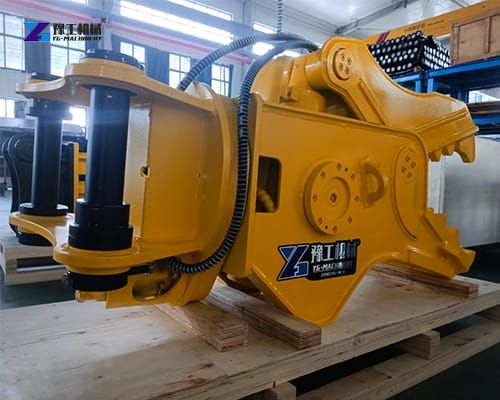
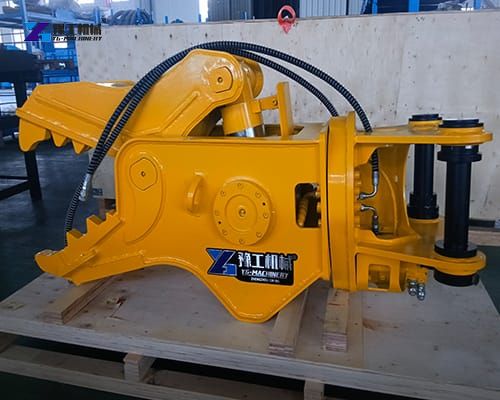
Concrete pulverizer attachment for excavator is a hydraulic attachment that mounts on an excavator arm. Its jaws close with immense force to crack, crush, and pulverize concrete structures. The attachment typically features two jaws—an upper jaw with fixed or replaceable teeth and a lower jaw that moves via hydraulic cylinders. Some models are designed strictly for crushing, while others include built-in shears for cutting rebar. Think of it as a set of mechanical jaws that bite into concrete walls, floors, foundations, and even bridge decks, reducing them to manageable rubble. The pulverizer attaches to the excavator using a pin grabber coupler or a fixed mounting bracket, and it draws hydraulic power directly from the machine’s auxiliary circuit. Different from a hydraulic breaker that hammers the material, a pulverizer applies steady, concentrated pressure, making it quieter and less prone to flying debris. Moreover, because it works by compression rather than impact, it causes less vibration stress to the excavator itself. This combination of efficiency, safety, and machine protection explains why more purchaser are adding concrete pulverizers to their fleets.
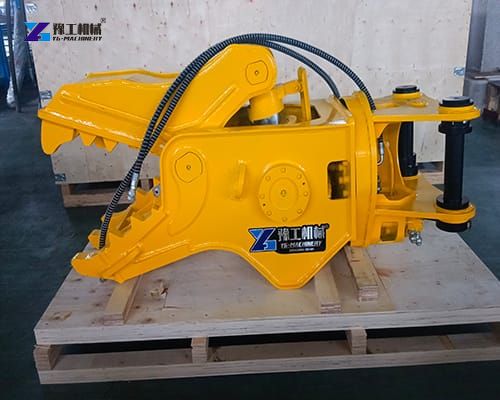
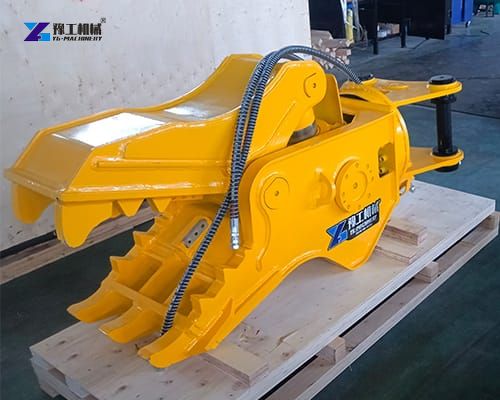
Concrete Pulverizer Attachment for Excavator
| Model | Unit | YG400 | YG600 | YG800 | YG1000 | YG1700 |
| Total length | mm | 1642 | 1895 | 2168 | 2218 | 3150 |
| Total width | mm | 1006 | 1275 | 1376 | 1598 | 2100 |
| Blade length | mm | 120 | 150 | 180 | 200 | 240 |
| Max Opening Height | mm | 587 | 718 | 890 | 1029 | 1400 |
| Upper Jaw Width | mm | 215 | 280 | 290 | 380 | 400 |
| Lower Jaw Width | mm | 458 | 586 | 588 | 720 | 812 |
| Max Shear Force | kn | 380 | 650 | 1650 | 2250 | 2503 |
| Working Pressure | Bar | 280 | 320 | 320 | 320 | 320 |
| Weight | kg | 670 | 1350 | 1750 | 2750 | 4709 |
| For Excavator Weight | ton | 6-9 | 10-15 | 18-26 | 26-30 | 50-80 |
Internal Structure And Mechanical Anatomy
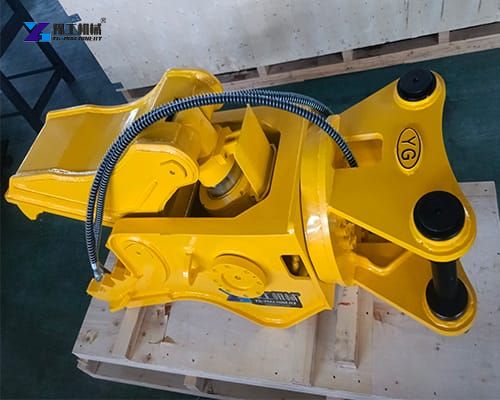
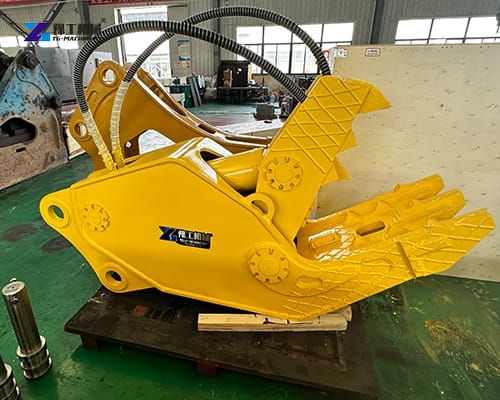
To appreciate how a concrete pulverizer attachment for excavator performs its magic, you need to look inside its steel bones. Every quality attachment shares a similar architecture, though dimensions vary by model.
- The main body is fabricated from high strength, wear resistant steel, often Hardox or equivalent, to withstand extreme forces and abrasive dust.
- The two main components are the upper jaw and the lower jaw. On most designs, the upper jaw remains stationary relative to the attachment frame, while the lower jaw swings upward to crush material against it.
- The crushing surfaces—often called blades or teeth—are the parts that directly contact concrete. Their length, shape, and material determine how deeply the jaw can bite into a structure. For instance, models like the YG400 offer a blade length of 120 millimeters, suitable for light demolition, while the YG1700 boasts a 240 millimeter blade, capable of gripping thick bridge beams.
- Between the jaws, you will find speed valves that allow the pulverizer to cycle quickly—opening and closing in under two seconds on responsive machines.
- The pivot points are reinforced with large diameter pins and replaceable bushings, because these joints endure millions of cycles over the attachment’s life.
How Does It Work? – The Science Of Crushing Concrete
Operating a concrete pulverizer attachment for excavator feels less like tearing and more like controlled fracturing. When you close the jaws onto a concrete element, the process follows three distinct phases.
- First, the sharp tips of the upper and lower jaws penetrate the surface, creating stress concentration points. Concrete is exceptionally strong in compression but weak in tension and shear. By focusing force on small areas, the pulverizer creates cracks that propagate rapidly through the matrix.
- Second, as the jaws continue closing, the crushed concrete falls away, exposing any steel reinforcement bars. This is where the pulverizer’s design shines: the gap between the upper and lower jaw is engineered so that concrete crumbles while rebar remains trapped. The operator then slightly repositions the jaws to cut the rebar, either using integrated shearing edges or by bending it back and forth until fatigue breaks it.
- Third, for complete recycling, the pulverizer can be cycled multiple times on the same material, reducing it to 50 to 100 millimeter pieces—ideal for use as backfill or road base. All of this happens because the excavator’s hydraulic system supplies oil at a consistent working pressure.
- The opening height of the jaws—ranging from 587 mm on the smallest model to 1400 mm on the largest—determines the maximum thickness of a single bite. An operator facing a 1 meter thick foundation would need a pulverizer with at least that opening height, or else must make multiple bites around the edges.
Practical Applications Across Industries
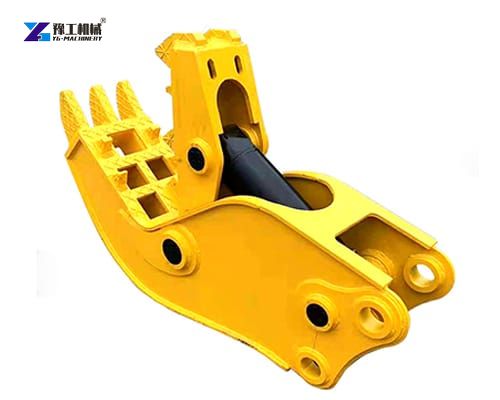
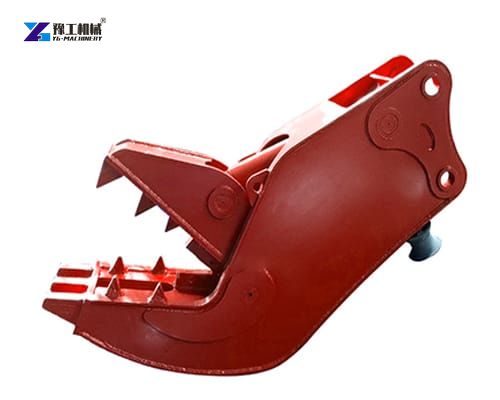
Where can you use a concrete pulverizer attachment for excavator? The short answer is anywhere concrete meets rebar.
Demolition contractors rely on it for tearing down buildings, parking garages, industrial plants, and bridges. Unlike a breaker that leaves tangled rebar and dust, a pulverizer separates materials on site, reducing handling costs.
In bridge rehabilitation, crews use pulverizers to remove concrete decks while leaving the steel girders intact—a delicate operation that requires precise control of jaw opening.
Recycling centers use concrete pulverizers mounted on stationary excavators or mobile carriers to process demolition debris into clean aggregate. The ability to shear rebar into short lengths means the steel can be magnetically separated and sold as scrap, creating an additional revenue stream.
Municipal utility projects benefit from pulverizers when breaking out manhole structures, vaults, or drainage channels without damaging adjacent pipes. Even the mining and tunneling industry has found uses: crushing shotcrete overspray and concrete linings to reclaim tunnel space.
A Comprehensive Purchasing and Selection Guide
Selecting the appropriate concrete pulverizer attachment for excavator requires a careful assessment of several operational variables.
Matching the attachment weight to the carrier excavator’s operating weight capacity is paramount. Operating an oversized pulverizer compromises machine stability, accelerates wear on front-end pins and bushings. Conversely, pairing an undersized attachment with a massive excavator results in underutilized hydraulic capacity and increases the risk of structurally damaging the attachment due to excessive carrier forces.
Contractors must also evaluate the specific nature of the material they intend to process. For sites dominated by thick, heavily reinforced foundation concrete, choosing a model with high maximum shear force and long, premium-grade rebar cutting blades is crucial. For sites focused primarily on breaking down flat concrete pavements or non-reinforced brickwork, a wider jaw opening with a staggered tooth pattern takes priority over extreme cutting force.
Finally, consider the compatibility of auxiliary hydraulic circuits. Ensure that the excavator’s auxiliary pump can deliver the required oil flow volume and maintain the necessary operating pressure as outlined by the attachment manufacturer. Insufficient flow rates result in sluggish cycle times, drastically lowering overall productivity.