
Selecting the right hydraulic rock saw for an excavator is an important decision for contractors, quarry operators, or demolition specialist can make. The rock saw offers precision, clean cuts, and minimal vibration, making it indispensable for trenching, pipeline installation, concrete demolition, and dimensional stone quarrying. However, with multiple models, rotation options, and technical specifications on the market, the selection process may be a challenge. This guide explains the key specifications we should consider when selecting a hydraulic rock saw for excavator applications and provides practical guidance for matching the saw to our machine.

Technical Data of the Hydraulic Rock Saw for Excavator
| Model/Motor Model | YSJ04 | YGJ06 | YSJ08 | YSJ10 | ||||
| Rotation Mode | Fixed Type | 360°Rotation | Fixed Type | 360°Rotation | Fixed Type | 360°Rotation | Fixed Type | 360°Rotation |
| Applicable excavators (T) | 6-12 | 6-12 | 12-20 | 12-20 | 20-30 | 20-30 | 30-40 | 30-40 |
| Machine weight (KG) | 200 | 260 | 350 | 450 | 500 | 600 | 500 | 700 |
| Saw blade size (mm) | 800 | 1200 | 1600 | 1800 | ||||
| Theoretical Displacement (ml/r) | 154 | 154 | 493 | 792 | ||||
| Torque (N.m) | 600 | 600 | 1923 | 3100 | ||||
| Peak Pressure (MPa) | 40 | 40 | 40 | 40 | ||||
| Unit Torque (N.m/MPa) | 24 | 24 | 76.9 | 124 | ||||
| Continuous Speed (r/min) | 1-650 | 1-650 | 1-550 | 1-500 | ||||
| Maximum Speed (r/min) | 1100 | 1100 | 800 | 600 | ||||
1. Understand Your Excavator’s Carrier Class
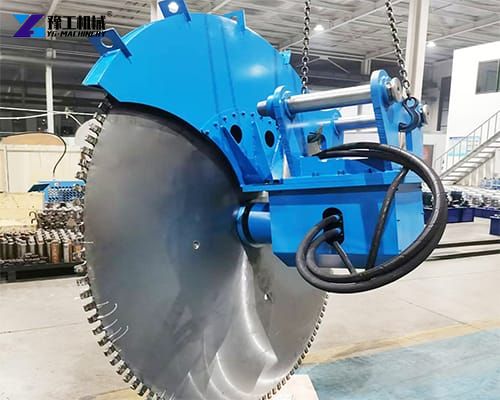
The first and most non-negotiable step is matching the attachment to your excavator’s operating weight. Installing a hydraulic rock saw for excavator that is too heavy will compromise your machine’s stability and slew performance, while an undersized unit will waste hydraulic power and reduce cutting efficiency.
Industry standard classifications group rock saws by tonnage ranges. For example:
- 6–12 ton excavators pair with compact rock saws weighing approximately 200–260 kg.
- 12–20 ton excavators require medium-duty units around 350–450 kg.
- 20–30 ton excavators need heavier attachments in the 500–600 kg range.
- 30–40 ton excavators demand high-mass saws up to 700 kg.
2. Fixed Type vs. 360° Rotation – Which Configuration Wins?
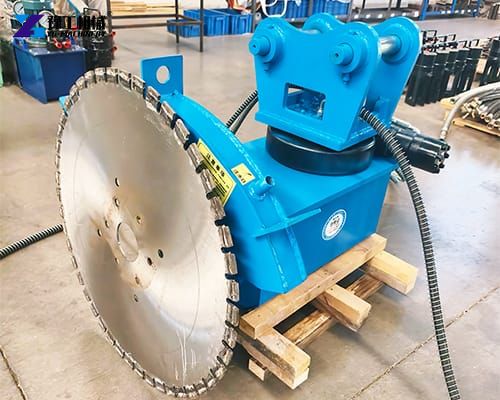
The choice between a fixed-type and a 360° rotation hydraulic rock saw for excavator directly impacts job site versatility. Fixed-type saws are rigidly mounted to the arm, meaning the blade always aligns with the boom’s orientation. This configuration is lighter (saving 60–100 kg on comparable models), more affordable, and perfectly adequate for straight-line trenching, flat ground profiling, and road cutting where the excavator can maneuver parallel to the cut.
However, a 360° rotation saw—often equipped with a hydraulic motor and slew ring—allows the blade to pivot independently of the boom. This unlocks several critical advantages:
- Angled cuts on slopes or embankments without repositioning the carrier.
- Parallel cutting alongside walls, curbs, or existing foundations.
- Precise box cuts in confined urban sites where space limits boom swing.
- Quick change between vertical and horizontal cutting planes.
The trade-off is higher initial cost, added weight, and slightly reduced hydraulic efficiency due to the extra motor. For general civil engineering, fixed type suffices. For demolition, quarrying, and utility work in congested environments, the 360° option pays for itself through reduced machine repositioning time.
3. Saw Blade Size – Bigger Isn’t Always Better
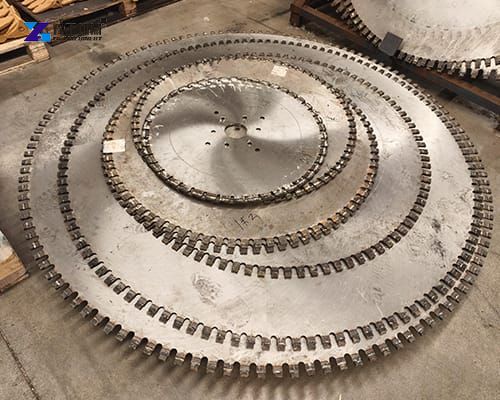
Blade diameter directly determines maximum cutting depth. However, larger blades introduce several trade-offs:
- Higher torque demand – a 1600 mm blade requires nearly triple the torque of an 800 mm blade.
- Increased weight – larger blades add unsprung mass, affecting boom dynamics.
- Reduced travel speed – bigger diameter lowers the maximum RPM at the same hydraulic flow.
Match blade size to your most frequent application:
- 800 mm – Ideal for curb cutting, asphalt repair, and shallow utility trenches (depth up to 300 mm).
- 1200 mm – Suitable for foundation footings, medium-depth pipeline crossings (depth up to 500 mm).
- 1600 mm – Designed for hard rock quarrying, heavy concrete demolition, and deep sewer lines (depth up to 700 mm).
- 1800 mm – Reserved for massive civil projects, mountain road cutting, and mining applications (depth over 800 mm).
4. Decode the Hydraulic Parameters – Flow, Pressure, and Torque
Theoretical Displacement (ml/r) – This figure tells you how much hydraulic fluid the motor consumes per revolution. Higher displacement (e.g., 792 ml/r vs. 154 ml/r) indicates a motor capable of moving more oil, thus generating greater torque. However, high-displacement motors require higher flow rates from your excavator’s auxiliary circuit. If your machine delivers only 120 L/min but the saw needs 200 L/min, the blade will rotate too slowly, causing premature tooth wear and inefficient cutting.
Torque (N.m) – Torque is the rotational force that actually breaks rock. For example, a saw rated at 3100 N.m can easily slice through granite and reinforced concrete, while a 600 N.m unit is better suited to soft sandstone or asphalt. Always compare torque against your expected material’s compressive strength. As a rule of thumb:
- Soft rock/asphalt: 600–1000 N.m
- Medium-hard rock (limestone, shale): 1000–2000 N.m
- Hard rock (granite, basalt, highly reinforced concrete): 2000+ N.m
Peak Pressure (MPa) – Most quality hydraulic rock saws for excavators operate at a peak of 40 MPa. Ensure your excavator’s relief valve setting does not exceed this limit; otherwise, you risk blowing internal seals. Conversely, if your machine’s pressure maxes out at 32 MPa, you will never achieve the rated torque—no matter how high the theoretical displacement.
Unit Torque (N.m/MPa) – This is a handy efficiency metric. Divide the maximum torque by the operating pressure to see how much torque you get per unit of hydraulic pressure. Higher unit torque (e.g., 124 vs. 24) indicates a more efficient motor design, translating to less fuel consumed per cubic meter of rock removed.
5. Speed – Continuous vs. Maximum RPM
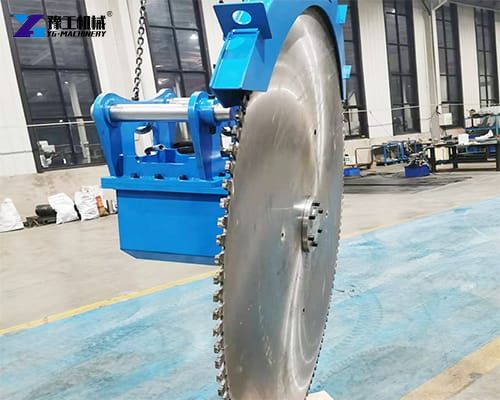
Continuous speed is the range where the saw can operate indefinitely without overheating. For most hydraulic rock saws for excavators, this lies between 1–650 or 1–550 r/min. Maximum speed is a short-term capability—useful for light trimming or flush cutting but never sustained.
Why does speed matter? Softer materials benefit from higher blade speed (600–650 rpm) to clear cuttings quickly and prevent glazing of diamond segments. Harder materials demand slower speeds (300–450 rpm) to allow each tooth to penetrate without excessive heat generation. If you primarily cut abrasive rock, prioritize a saw with a lower continuous speed but higher torque, as this combination reduces tooth wear and extends blade life.
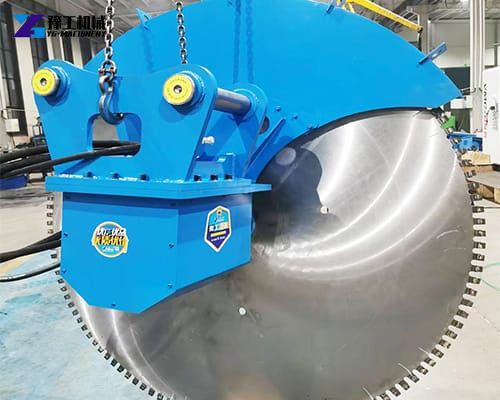
6. Hydraulic Compatibility – The Overlooked Showstopper
Even if the torque and speed specs align, you must verify three hydraulic parameters:
- Auxiliary flow rate (L/min) – Compare the saw’s required flow against your excavator’s maximum auxiliary pump output. Undersupply causes slow cutting; oversupply triggers overheating or cavitation.
- Return line backpressure – Some high-displacement motors require a case drain line to relieve internal pressure. Ensure your excavator has a dedicated return port.
- Cooling capacity – Continuous rock sawing generates intense heat. Verify that your excavator’s hydraulic oil cooler can handle the additional thermal load.