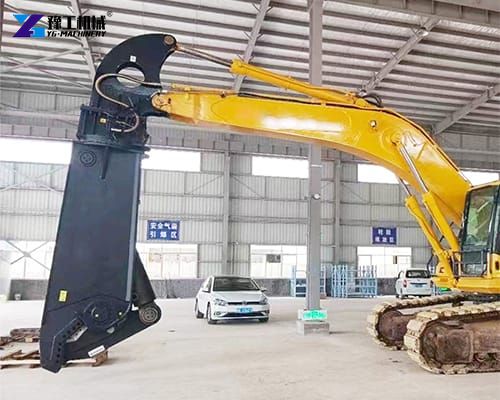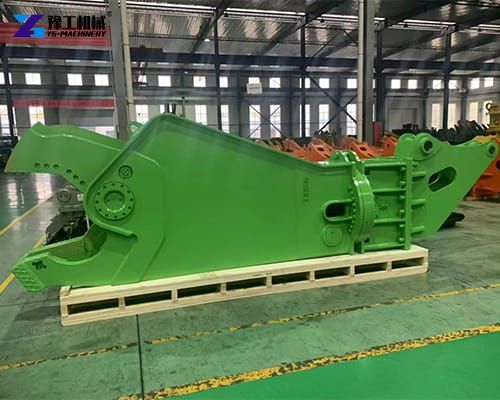
Every project presents unique challenges. A bridge demolition requires different cutting capabilities than a scrap recycling yard. Steel structures demand different performance characteristics than reinforced concrete buildings. An excavator shear that excels in one environment may perform poorly in another.
Specifications provide measurable information that predicts how well an attachment will perform under specific working conditions. Instead of relying on marketing language, buyers should compare numerical values and engineering data that directly affect productivity.
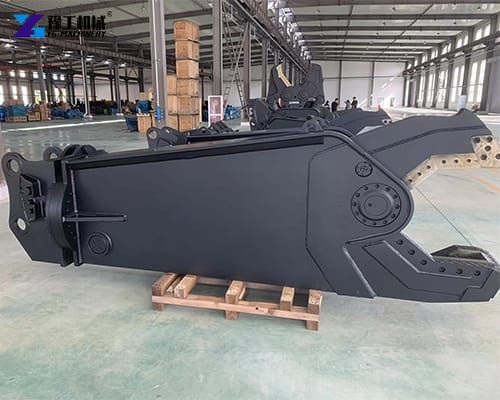
Parameters of the Excavator Shear Attachments
| Model | YG50R | YG100R | YG130R | YG180R | YG310R | YG410R |
| Forearm-mounted model | 6-9T | 10-12T | 13-17T | 18-27T | 28-39T | 39-50T |
| Large arm installation model | 4-6T | 7-10T | 8-12T | 14-18T | 20-28T | 28-39T |
| Work pressure | 35Mpa | 35Mpa | 35Mpa | 35Mpa | 35Mpa | 35Mpa |
| Overall length | 2000mm | 2200mm | 2300mm | 2900mm | 3500mm | 3900mm |
| Overall weight | 650KG | 1100KG | 1220KG | 2100KG | 3300KG | 4700KG |
| Maximum opening | 290mm | 375mm | 375mm | 445mm | 565mm | 670mm |
| Throat depth | 290mm | 395mm | 395mm | 525mm | 630mm | 720mm |
| Front-end crushing force | 46T | 60T | 60T | 85T | 135T | 172T |
| Central crushing force | 115KN | 150KN | 150KN | 221KN | 351KN | 464KN |
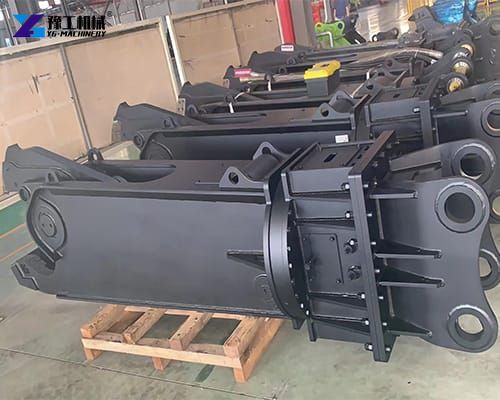
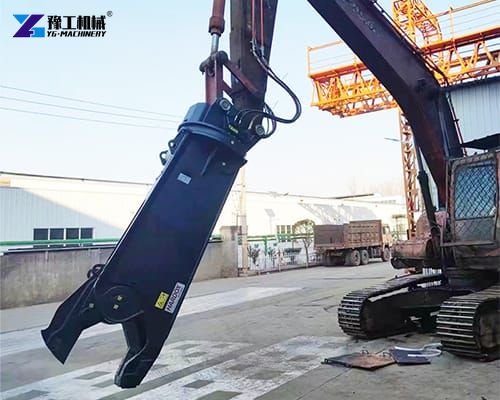
When reviewing specifications, think of them as a blueprint of the machine’s capabilities. They reveal how much force the shear can generate, what materials it can cut, how efficiently it operates, and how long it is likely to last.
- Cutting Force
Among all hydraulic shear attachment specifications, cutting force deserves immediate attention. Cutting force refers to the amount of pressure applied by the blades when cutting through steel or other materials. Higher cutting force generally enables the shear to process thicker structural steel, heavy beams, reinforced pipes, and industrial components with greater ease. However, bigger numbers are not always better. Excessive cutting force paired with an undersized excavator may reduce efficiency because the carrier machine cannot fully utilize the attachment’s capabilities. Buyers should ensure that the cutting force matches both the excavator’s hydraulic system and the intended application. - Jaw Opening Width
The jaw opening determines the maximum size of material that can fit inside the shear before cutting begins. A wider jaw opening offers several advantages. Large steel beams can be processed without repositioning. Bulky scrap materials become easier to handle. Demolition speed increases because fewer cutting cycles are required. However, an extremely wide jaw may reduce precision for smaller cutting tasks. Buyers should balance opening width with the typical dimensions of materials encountered on their projects. - Jaw Depth
Jaw depth is another specification that often receives less attention than it deserves. Deep jaws allow the shear to grip materials more securely before cutting. This improves stability and minimizes slipping, especially when handling round pipes or irregular steel sections. A deeper jaw also helps operators maintain control while dismantling complex structures where precise positioning is essential. - Blade Material Quality
The blades perform the hardest work during every operation. Premium excavator shears typically use high-strength alloy steel that has undergone advanced heat treatment processes. Blade hardness directly affects cutting performance, wear resistance, and service life. - Replaceable blade inserts provide significant long-term advantages.
Instead of replacing the entire jaw assembly after wear occurs, operators simply replace the cutting edges, reducing maintenance costs and minimizing downtime. - Hydraulic Pressure Requirements
Hydraulic pressure powers every cutting cycle. Each hydraulic shear excavator is designed to operate within a specified hydraulic pressure range. Operating below the recommended pressure reduces cutting efficiency, while excessive pressure may damage internal components. - Before purchasing, buyers should verify compatibility between the shear and their excavator’s hydraulic system. Key specifications include operating pressure, maximum pressure, and return pressure. Matching hydraulic pressure ensures optimal performance while extending component life.
- Hydraulic Flow Rate
Flow rate determines how quickly hydraulic oil reaches the attachment. A properly matched hydraulic flow allows the shear to open and close smoothly and efficiently. - Insufficient flow results in slower cycle times.
Excessive flow may generate unnecessary heat and reduce hydraulic system efficiency. Fast cycle times improve productivity during repetitive cutting operations, making hydraulic flow one of the most important specifications for high-volume demolition projects. - Rotation System
Modern excavator shears often include hydraulic rotation systems. Rotation allows operators to position the shear at virtually any angle without constantly repositioning the excavator itself. Continuous 360-degree rotation significantly improves efficiency. It enables operators to approach materials from optimal cutting angles while reducing unnecessary machine movement. - Overall Weight
Attachment weight influences several aspects of performance. Heavier shears often deliver greater cutting force because of stronger structural components. However, excessive weight reduces excavator stability and lifting capacity. The ideal attachment weight depends on the carrier machine’s operating weight and lifting specifications.YG Attachments will recommend the appropriate excavator weight class for each shear model.