
When you work in quarrying, demolition, road construction, trenching, or rock excavation projects, a rock saw attachment plays an important role. The right excavator rock saw can slice through hard rock, concrete, stone, and asphalt with high efficiency, cut down project cycle time, and reduce manual labour costs. However, picking an unsuitable rock saw for excavator will lead to slow cutting speed, frequent equipment failure, high fuel consumption, and even damage to your host excavator. This guide will help us through eight critical factors—from excavator tonnage and hydraulic flow to blade size, torque, rotation type, and real-world application— so we can make an informed investment.
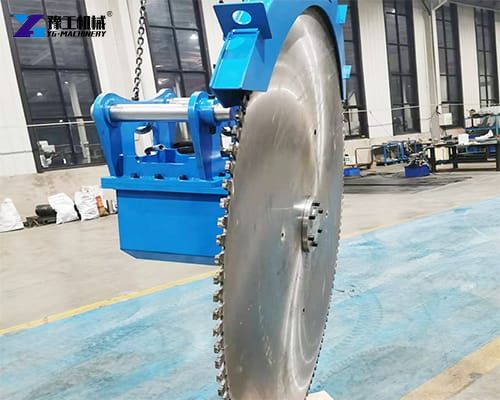
What exactly is an Excavator rock saw?
A rock saw is a hydraulic‑powered work tool mounted directly onto an excavator. It uses a high‑strength rotating saw blade to cut rock, concrete, and hard materials. Unlike traditional hammer breakers that crush material by impact force, rock saw attachments perform precise cutting. They create clean, straight cuts, which is ideal for trenching, rock profiling, wall cutting, and dimension stone mining. There are two main modes for excavator rock saws. The fixed‑type rock saw keeps the saw body in a stable position, perfect for linear straight cutting tasks. The 360‑degree rotation rock saw allows the saw unit to spin freely, supporting multi‑angle cutting for complex‑shaped workpieces. Before you start comparing different excavator rock saws models, we need to clarify the actual project requirements.

Excavator rock saw Specifications
| Model/Motor Model | YSJ04 | YGJ06 | YSJ08 | YSJ10 | ||||
| Rotation Mode | Fixed Type | 360°Rotation | Fixed Type | 360°Rotation | Fixed Type | 360°Rotation | Fixed Type | 360°Rotation |
| Applicable excavators (T) | 6-12 | 6-12 | 12-20 | 12-20 | 20-30 | 20-30 | 30-40 | 30-40 |
| Machine weight (KG) | 200 | 260 | 350 | 450 | 500 | 600 | 500 | 700 |
| Saw blade size (mm) | 800 | 1200 | 1600 | 1800 | ||||
| Theoretical Displacement (ml/r) | 154 | 154 | 493 | 792 | ||||
| Torque (N.m) | 600 | 600 | 1923 | 3100 | ||||
| Peak Pressure (MPa) | 40 | 40 | 40 | 40 | ||||
| Unit Torque (N.m/MPa) | 24 | 24 | 76.9 | 124 | ||||
| Continuous Speed (r/min) | 1-650 | 1-650 | 1-550 | 1-500 | ||||
| Maximum Speed (r/min) | 1100 | 1100 | 800 | 600 | ||||
Key Technical Parameters to Evaluate When Choosing a Rock Saw Attachment – 8 Tips
1. The first and most important selection factor is host machine compatibility.
The rock saw attachment must match your excavator perfectly. The very first index is excavator tonnage. Different excavator rock saw models are engineered for specific weight classes of excavators. Small‑spec excavator mounted rock saws fit 6‑12 ton excavators, mid‑range units suit 12‑20 ton and 20‑30 ton machines, while heavy‑duty types are designed for 30‑40 ton large excavators. If you install a heavy one nt on a too‑light excavator, the host machine will lack sufficient power output. The excavator arm will struggle to support the attachment weight, leading to unstable operation, arm shaking and potential structural harm. Conversely, mounting a small excavator rock saw on a large heavy‑duty excavator wastes the host machine’s power potential, and you cannot maximise cutting performance.
2. Besides machine weight, the operating weight of the rock saw attachment itself cannot be ignored.
Each rock saw model has its own machine weight. For instance, entry‑level rock saw for excavator weigh around 200kg for fixed version and 260kg for 360‑degree rotation version. As the model upgrades, the weight rises to 350kg, 450kg, 500kg, 600kg and higher. The total weight of the attachment must fall within the lifting capacity range of your excavator’s boom and arm. Excessive attachment weight creates safety risks during operation.
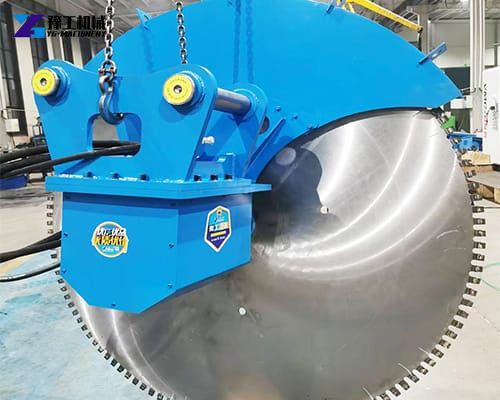
3. Hydraulic parameters are another core matching point for the excavator rock saw attachment.
Key hydraulic indicators include theoretical displacement, torque value, peak working pressure and unit torque. Theoretical displacement directly determines the hydraulic motor’s oil demand. Torque reflects the cutting power of the excavator rock saw. Higher torque enables the saw blade to bite into extra‑hard rock without stalling. Peak pressure for most standard rock saw for excavator sits at 40 MPa. Your excavator’s auxiliary hydraulic system must deliver pressure and flow that align with the specifications. Continuous speed and maximum speed define the rotation performance of the saw motor. Continuous working speed covers the daily regular cutting rotation range, while maximum speed represents the peak rotational capacity. Smaller models can reach maximum speeds up to 1100 r/min, and larger heavy‑duty model adopt relatively lower maximum speeds to guarantee high‑torque cutting force. We should check our excavator auxiliary flow and pressure data before finalising our rock saw attachment purchase. If hydraulic supply does not match, the rock saw will either run sluggishly or suffer premature internal motor wear.
4. Our cutting application and material type heavily influence which one you should buy.
Think about what material you mostly cut on site. Soft limestone, hard granite, reinforced concrete, asphalt and sandstone all bring different cutting challenges. Granite and other ultra‑hard rock demand high‑torque rock saw attachments. Low‑torque machine will frequently stall when cutting tough rock, slowing down progress and wearing down saw blades rapidly. If you mainly process softer rock or asphalt, you do not need to invest in the highest‑torque heavy‑duty type, which helps you control equipment investment costs.
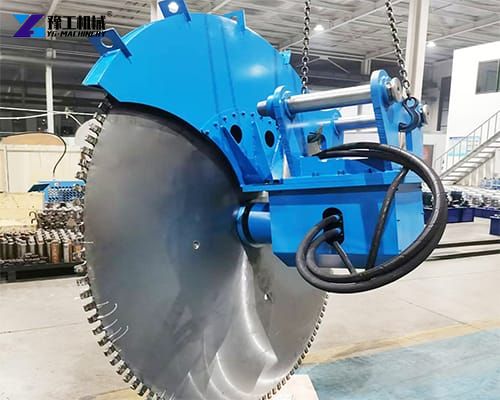
5. Saw blade size is closely linked to your cutting depth requirements. Saw blade sizes for rock saw attachments vary widely.
Common specifications include 800 mm, 1200 mm, 1600 mm and 1800 mm. Larger saw blades achieve deeper cutting depth. If your project needs deep trench cutting, you need to select a rock saw attachment that supports bigger saw blade diameter. However, larger saw blades require higher output torque from the hydraulic motor. Oversized saw blades on an under‑powered rock saw for excavator result in poor cutting performance and accelerated blade abrasion. Always match saw blade dimension to both your target cutting depth and machine motor parameters.
6. Choose between fixed‑type and 360‑degree rotation rock saw for excavator versions.
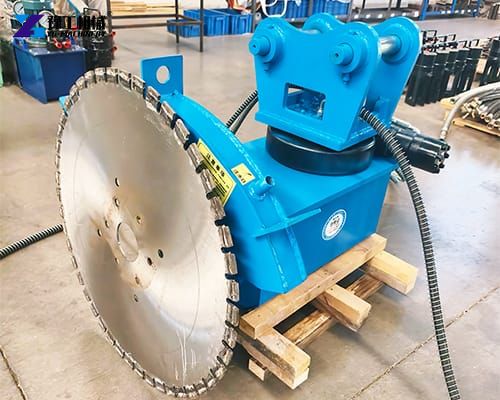
Fixed‑type rock saw attachments are cost‑effective. They excel at long straight cuts such as linear trenching, road slotting. Their structure is simpler, with fewer moving parts, so maintenance workload is lower. The 360‑degree rotation type can rotate the whole cutting unit freely. This variant fits complex jobs, including curved cutting, vertical wall trimming, stone block shaping and multi‑angle profiling work. The rotating structure adds extra weight and cost. If most of your work is straight linear cutting, fixed‑type will be a more economical pick. If your site involves frequent multi‑angle cutting work, investing in a 360‑degree rotation rock saw attachment brings huge flexibility advantages.
7. Service and after‑sales support should not be overlooked when buying an excavator mounted rock saw.
No heavy‑duty construction tool can avoid wear and occasional breakdowns. Before placing your order, confirm spare‑part supply for your rock saw attachment. Check whether replacement hydraulic motors, saw blades, cutting teeth and sealing kits can be obtained quickly. It is also wise to ask about technical support. Reliable machine suppliers can provide parameter matching consultation, installation guidance and on‑site troubleshooting advice. Many buyers only focus on upfront price, ignoring after‑sales service. A cheap one with poor support often turns out to be more expensive in the long run.
8. Budget is a practical factor for every equipment buyer.
Its price varies significantly based on model, torque capacity, rotation mode and build quality. Higher‑torque, 360‑degree rotation heavy‑duty rock saw for excavator come with higher purchase prices. Do not automatically chase the lowest‑priced rock saw attachment. Low‑cost rock saws often use low‑grade hydraulic components and thin steel plates. They suffer frequent breakdowns on tough job sites. On the other hand, you do not have to over‑specify your excavator rock saw. Buying an over‑powered heavy‑duty excavator mounted rock saw for light‑duty cutting tasks creates unnecessary capital waste. Balance your site requirements, host machine condition and long‑term operation cost to find the most cost‑effective solution.