
Round pile breaker has become an increasingly valuable solution for contractors working on foundation construction, bridge projects, infrastructure development, and building foundations. However, choosing a concrete pile breaker is not simply a matter of selecting the largest machine available. One of the most important decisions is determining how many breaking modules the equipment should have. The number of modules directly influences how the machine surrounds the pile, distributes breaking force, adapts to different pile diameters, and performs during continuous construction operations.
So, how do you select the right number of modules for a hydraulic pile breaker? The answer depends on several interconnected factors, including pile diameter, breaking efficiency, excavator compatibility, construction conditions, equipment weight, and project requirements. Understanding these factors will help you make a more informed purchasing decision and avoid investing in equipment that does not match your actual working conditions.
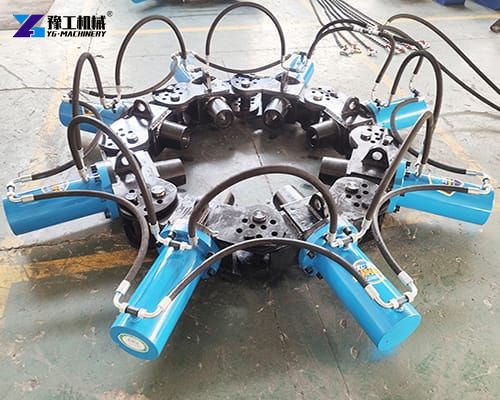
How Does A Round Pile Breaker Work?
Before discussing module selection, it is important to understand the working principle of a pile head breaking machine for round piles.
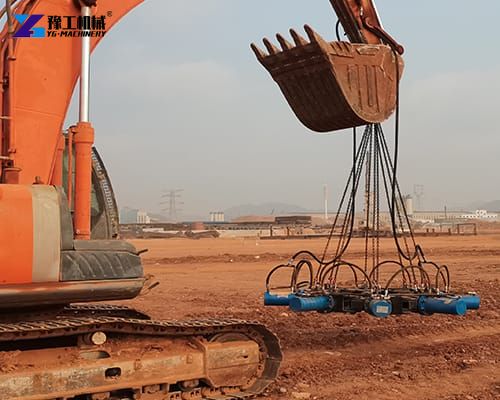
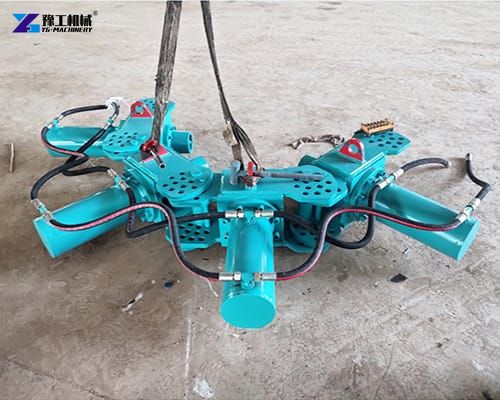
The concrete pile breaker is a hydraulic attachment designed to remove excess concrete from the top of a concrete pile. It generally consists of a supporting frame, multiple hydraulic breaking modules, hydraulic cylinders, connecting structures, and cutting or crushing components.
During operation, the attachment is positioned around the pile head. Hydraulic power drives the cylinders, causing the breaking components to apply pressure to the concrete from multiple directions. As the breaking force acts around the pile, the excess concrete is progressively fractured and separated.
The main advantage of this design is that the pile can be processed from several directions rather than relying on workers to break the concrete manually with handheld tools.
The breaking modules are the most important working components of the equipment. They determine how many contact points are available around the pile and how the hydraulic force is distributed during operation.
Think of the modules as a coordinated team. Each module has its own position and working area, but all modules cooperate to complete the same task. A well-matched configuration helps the equipment maintain stable contact with the pile and achieve effective concrete removal.
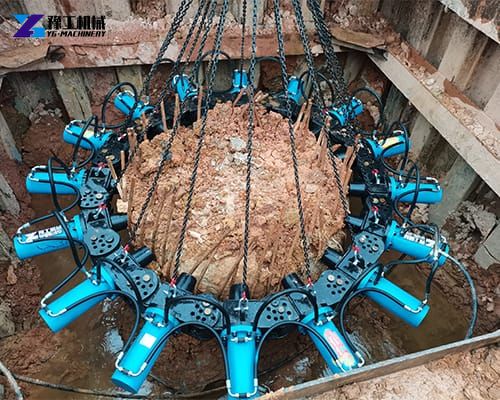
Consider the Diameter of the Concrete Pile
Pile diameter should be the starting point when selecting the number of modules.
Different construction projects use different pile diameters depending on structural design, soil conditions, foundation requirements, and load-bearing expectations.
The round pile breaker must be capable of fitting around the pile while allowing its breaking components to work effectively. The attachment should provide sufficient working coverage without being excessively large or difficult to position.
Smaller piles generally require a more compact configuration, while larger piles often need additional modules to distribute breaking force around a wider circumference.
However, pile diameter should not be considered in isolation. The actual breaking requirements, concrete characteristics, and equipment design must also be evaluated.
For example, two projects may involve piles with similar diameters but different concrete strengths or reinforcement arrangements. Their breaking conditions may therefore differ, even though their basic dimensional requirements appear similar.
Another important consideration is whether the pile diameters remain consistent throughout the project. If a contractor frequently works with different pile sizes, purchasing a configuration that offers greater application flexibility may be more practical than choosing equipment designed for only one specific pile dimension.
The best approach is to identify the actual pile diameter range encountered in daily operations and select a compatible machine accordingly.
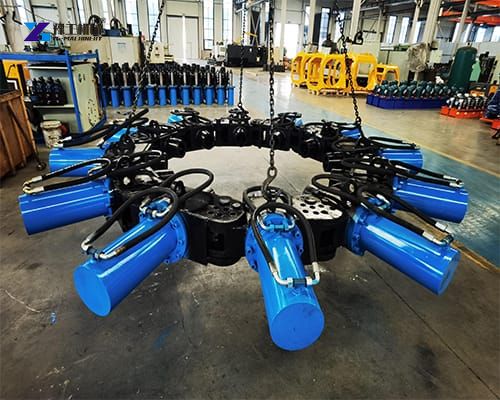
Match the Module Configuration to the Pile Diameter Range
Manufacturers usually provide several round pile breaker models with different module configurations. These options allow buyers to select equipment according to their intended applications rather than relying on a single universal design.
For example, the product specifications shown in the supplied reference table illustrate how module quantity increases alongside the applicable pile diameter range. The YG-800 model has eight modules and is designed for pile diameters of 600–800 mm, while the YG-980 has nine modules for 800–900 mm piles. The configuration continues to increase across the product range, reaching eighteen modules on the YG-2500 model, which accommodates pile diameters of 2300–2500 mm. The corresponding machine weights also increase from 2400 kg to 5400 kg, demonstrating the relationship between equipment size, module quantity, and overall structural requirements. This product range provides a useful starting point for comparing different configurations, although the final selection should always consider the manufacturer’s application recommendations and the actual conditions of the project.
Importantly, a larger number of modules does not automatically mean better breaking performance. The configuration must be designed to work with the corresponding pile dimensions and hydraulic system. People should therefore avoid selecting equipment simply because it has more modules than another model. Instead, we should compare the applicable diameter range, attachment dimensions, working arrangement, and compatibility with their excavator.
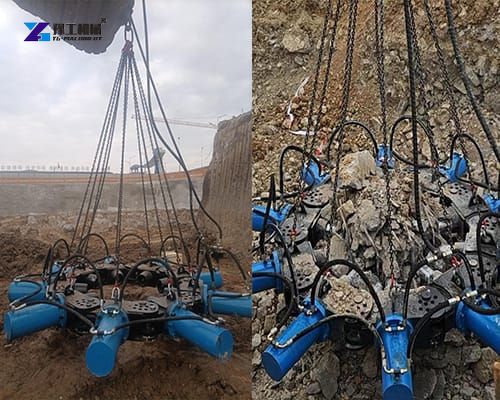
Consider Excavator Compatibility
Even a well-designed concrete pile breaking machine for round piles cannot perform effectively without a suitable hydraulic power source.
The excavator is responsible for lifting, positioning, supporting, and supplying hydraulic power to the attachment. Therefore, excavator compatibility should be considered before purchasing a particular module configuration.
The first consideration is the excavator’s operating weight and lifting capacity.
As the number of modules increases, the overall weight and dimensions of the round pile breaker generally increase as well. The excavator must be capable of handling the attachment safely while maintaining sufficient stability during positioning and operation.
An undersized excavator may experience difficulties when lifting or maneuvering a heavy attachment. This can affect operating efficiency and introduce unnecessary safety risks.
The second consideration is the hydraulic system.
Contractors should verify whether the excavator can provide the required hydraulic flow and pressure for the selected pile breaker. The hydraulic connections, hose specifications, control functions, and oil supply arrangements should also be checked.
A mismatch between the attachment and excavator can result in poor working performance, excessive heating, or unnecessary strain on hydraulic components.
When selecting a model with more modules, it is especially important to confirm that the supporting hydraulic equipment can meet its operating requirements.
If the project uses a stationary hydraulic power station rather than a conventional excavator, the power supply and hydraulic control arrangement should also be evaluated.
In short, selecting the module quantity and selecting the supporting machine should be treated as parts of the same decision.
Understand the Relationship Between Module Quantity and Equipment Weight
Equipment weight is often overlooked during the purchasing process, but it has a significant influence on transportation, installation, lifting, and daily operation. A round pile breaker with more modules generally requires a larger supporting frame and additional structural components. Consequently, its overall weight is usually greater. This creates a practical relationship between the desired working diameter and the supporting equipment.
If the attachment is too heavy for the excavator, the operator may experience difficulties maintaining stability. Transportation can also become more complicated, particularly when equipment needs to move between several construction sites. Before making a purchase, contractors should consider the complete operating weight of the attachment and the lifting capacity of the excavator at the actual working radius. It is also worth considering the working environment. Construction sites with limited access, narrow working areas, or restricted transportation routes may benefit from a more compact solution.
For large foundation projects, however, a heavier configuration may be entirely appropriate when the excavator and site conditions can support it. The right choice is the one that delivers the required working capacity without creating unnecessary operational limitations.
Why Does The Number Of Modules Matter?
The number of modules is not just a specification listed in a product catalog. It is a fundamental design factor that affects the practical performance of a round pile breaker. A suitable module configuration allows the equipment to match the pile circumference, maintain balanced pressure, and complete breaking operations efficiently. If the number of modules is insufficient for the intended application, the equipment may not provide the desired coverage around the pile. The operator might need to reposition the attachment more frequently, potentially increasing working time and reducing overall productivity.
On the other hand, selecting an unnecessarily large configuration may increase equipment weight, purchasing costs, and hydraulic system requirements without providing meaningful benefits for the actual project. The objective is therefore not to maximize the number of modules. It is to find the most appropriate balance between breaking coverage, mechanical performance, and operational efficiency. This is why contractors should evaluate the application before choosing a particular model.
A Practical Selection Process
Selecting the appropriate number of modules becomes much easier when the decision follows a logical process.
Start by collecting accurate information about the pile diameters used on the project. Include the expected range rather than relying on a single representative measurement.
Next, identify the construction requirements, including the expected workload, concrete characteristics, reinforcement conditions, and required pile head finish.
Then, compare the available round pile breaker models and identify which configurations are recommended for the intended diameter range.