
Clamshell bucket for sale in YG Machinery, named for its resemblance to a clam’s hinged shell, consists of two opposing steel shells. These two shells are connected through a support structure and powered by hydraulic systems, ropes, or mechanical devices, depending on the bucket design. It attaches to a boom or arm via a suspension system, and its operation relies on either hydraulic cylinders or mechanical cables. The design is deceptively simple, yet it delivers extraordinary gripping power and payload control. It is commonly used for lifting sand, gravel, coal, soil, minerals, grain, scrap materials, and other bulk products. Unlike a standard digging bucket that scoops from the front, the clamshell grabs vertically from above, making it ideal for deep excavations, underwater dredging, and high-reach applications where horizontal access is limited.
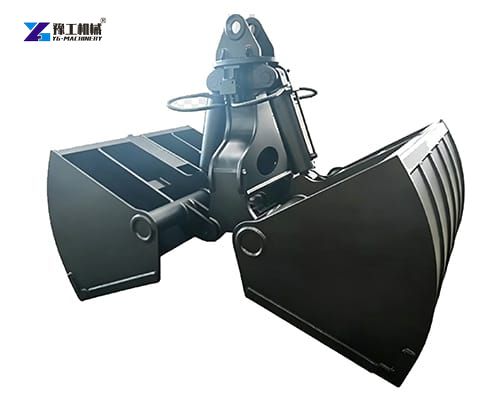
Parameters of Clamshell Bucket for Sale
| Item/Model | Unit | YGCS04 | YGCS06 | YGCS08 | YGCS10 |
| Suitable Excavator | ton | 7-11 | 12-18 | 18-25 | 26-35 |
| Weight | kg | 800 | 1200 | 2000 | 2300 |
| Opening | mm | 1000 | 1500 | 2200 | 2300 |
| Working Pressure | bar | 180 | 210 | 250 | 250 |
| Set Up Pressure | bar | 250 | 290 | 320 | 340 |
| Working Flow | lpm | 190 | 210 | 220 | 240 |
Features of Clamshell Bucket Attachment
Strong Structural Design
The bucket body is usually manufactured from heavy-duty steel materials that can withstand repeated impact and heavy loads. Reinforced plates and strong hinge systems help prevent deformation during operation.
High Grabbing Efficiency
The two bucket shells are designed to close tightly around materials. This allows operators to collect large amounts of material in a single cycle, reducing loading time and increasing productivity.
Flexible Operation
The clamshell bucket for sale can work in different conditions, including construction sites, ports, warehouses, and mining areas. Their flexible design allows them to handle materials with different densities and sizes.
Excellent Wear Resistance
Because the bucket often contacts abrasive materials, wear-resistant steel and replaceable components are commonly used. This extends equipment life and lowers maintenance expenses.
Different Capacity Options
Clamshell grab buckets are available in various sizes and capacities. Small models are suitable for light-duty operations, while larger models are designed for high-volume industrial projects.
Reliable Control Systems
Hydraulic and mechanical control systems provide smooth opening and closing movements. This improves accuracy and reduces material loss during handling.
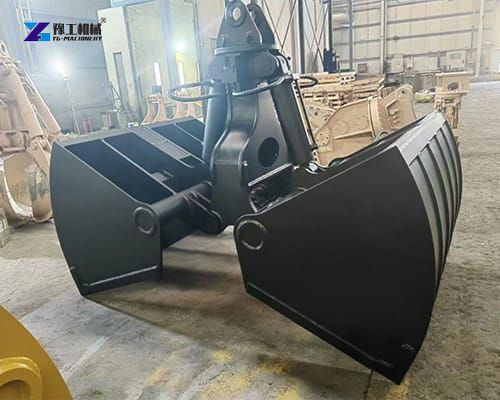
Diverse Applications Across Industries
- In construction, the clamshell bucket for sale handles excavated soil, trench backfill, and demolition concrete.
- In ports, it unloads bulk cargo ships – grains, fertilizers, and pellets – with minimal dust generation compared to conveyor belts.
- In environmental remediation, it removes contaminated sediment from riverbeds and ponds without disturbing the surrounding water.
- Scrap yards rely on heavy-duty clamshells to grapple shredded cars and ferrous scrap, while power plants use them to feed coal hoppers.
- Dredging operations, both marine and inland, favor clamshells for their ability to work. The bucket’s positive closure ensures that fine silt and sand do not wash out during ascent.
- In mining, it serves as a primary extraction tool for alluvial deposits and as a clean-up bucket for spillage.
- Even in agriculture, large clamshells move grain, silage, and compost.
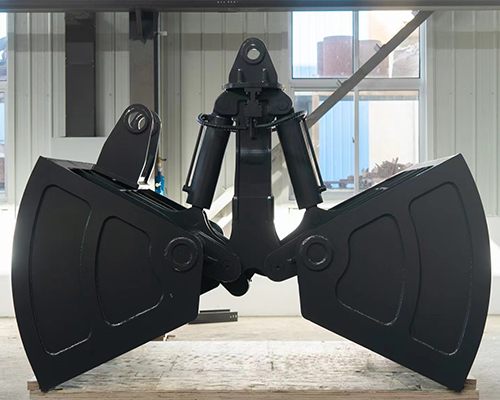
Advantages of Hydraulic Clamshell Bucket
Improved Productivity
The biggest advantage is faster material handling. The clamshell bucket for excavator can collect and transport materials in fewer cycles compared with manual methods or less efficient attachments.
Reduced Labor Requirements
Because the bucket performs grabbing and lifting automatically, fewer workers are needed for material movement. This lowers operational costs.
Better Access In Difficult Areas
Traditional equipment may struggle in deep, narrow, or restricted areas. The clamshell bucket for sale can reach locations that are difficult for standard digging tools.
Long Service Life
A well manufactured clam shell bucket can operate for many years when properly maintained. Strong materials and replaceable wear parts improve durability.
Enhanced Safety
Mechanical material handling reduces the need for workers to operate near heavy loads, improving workplace safety.
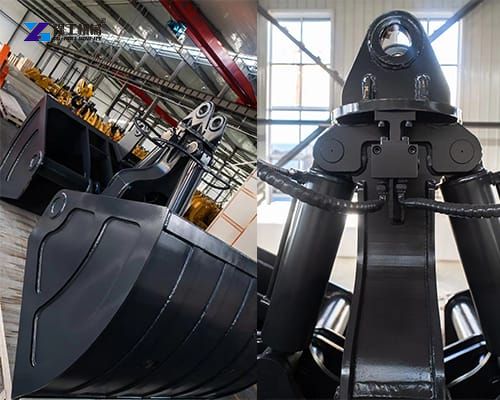
Working Principle of the Excavator Clamshell Bucket
- First, the clamshell bucket for sale is positioned above or inside the target material. The shells open fully and move downward. Once the bucket reaches the required depth, the control system activates the closing mechanism.
- The two shells move together and capture the material between them. The bucket then lifts the collected material and transports it to the desired location. When the bucket reaches the unloading area, the shells open and release the material.
- This repeated cycle allows continuous material handling with minimal manual intervention.
- Hydraulic systems provide precise control, while mechanical rope systems offer strong lifting capability for large-scale operations.
How to Choose the Right Clamshell Bucket for Sale?
Material Type
Different materials require different bucket designs. Loose materials may need a standard bucket, while heavy or abrasive materials require reinforced models.
Capacity Requirements
The bucket size should match the lifting equipment and project needs. A bucket that is too large may overload the machine, while a bucket that is too small may reduce efficiency.
Operating Environment
Consider whether the bucket will work on land, underwater, in ports, or in mining environments. Each condition requires a different design.
Equipment Compatibility
The bucket must match the excavator. Checking weight limits, connection methods, and hydraulic requirements is essential.
Quality Standards
Buyers should look for manufacturers that use reliable materials and proven production methods. A low price may not always represent the best long-term value.