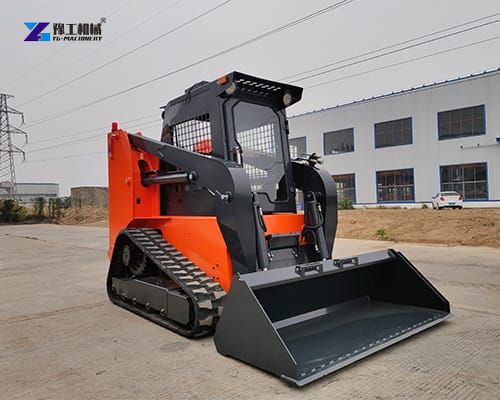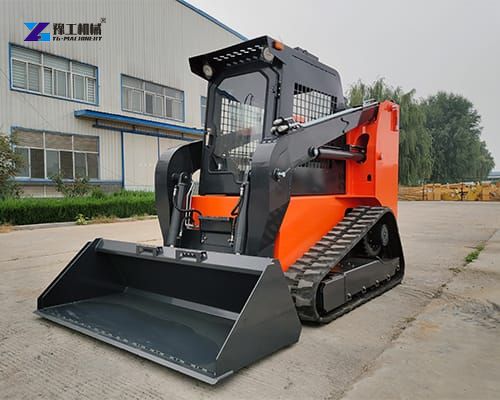
Skid steer track loader is a compact construction machine that uses continuous rubber tracks instead of conventional tires. Steering is achieved by independently controlling the left and right tracks, allowing the machine to pivot within its own footprint. It distributes weight over a larger contact area, reducing ground pressure while improving traction. This makes them ideal for soft, wet, or unstable surfaces where wheel slippage would otherwise reduce productivity. Modern tracked skid steer loaders are engineered for versatility. Their quick attachment systems enable operators to switch from a bucket to forks, augers, trenchers, breakers, grapples, sweepers, or snow blowers within minutes.
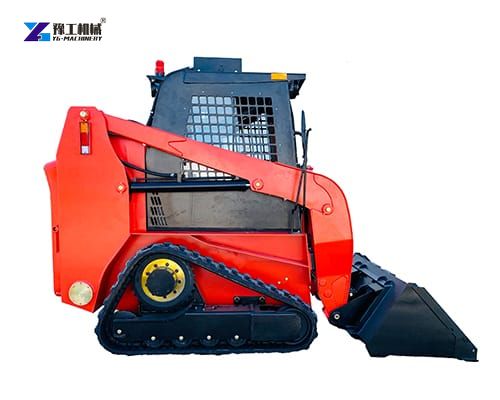
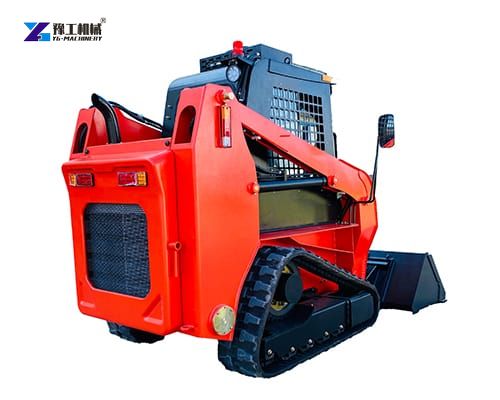
Parameters of Skid Steer Track Loader
| Model | YGT50 | YGT65 |
| Operating load (kg) | 700 | 1000 |
| Max Speed(km/h) | 10 | 12 |
| Rated flux (L/min) | 80 | 89 |
| Rated power (kw) | 45 | 55 |
| Fuel tank capacity (L) | 50 | 90 |
| Self-weight bucket (kg) | 4074 | 5024 |
| Bucket capacity (m³) | 0.4 | 0.5 |
| Overall operating height (mm) | 3660 | 3900 |
| Height to bucket hinge pin (mm) | 2730 | 2970 |
| Height to top of cab (mm) | 2349 | 2409 |
| Height to bottom of level bucket(mm) | 2500 | 2790 |
| Without bucket length(mm) | 2170 | 2450 |
| Overall length with bucket(mm) | 3150 | 3400 |
| Dumping angle at maximum height(° ) | 40 | 40 |
| Dumping height(mm) | 1990 | 2270 |
| Dumping reach(mm) | 1040 | 1120 |
| Rollback of bucket on ground(° ) | 30 | 30 |
| Rollback of bucket at full height(° ) | 100 | 100 |
| Wheelbase(mm) | 1230 | 1500 |
| Ground clearance(mm) | 230 | 200 |
| Angle of departure(° ) | 18.5 | 18.5 |
| Front turning radius without bucket(mm) | 1064 | 1230 |
| Front tuning radius(mm) | 1825 | 2010 |
| Rear tuning radius(mm) | 1264 | 1720 |
| Rear axle to bumper (mm) | 590 | 730 |
| Tread width (mm) | 1022 | 1482 |
| Width (mm) | 1422 | 1782 |
| Bucket width (mm) | 1727 | 1828 |
Why the Skid Steer Track Loader Is So Popular?
- Excellent maneuverability allows operation in confined construction sites.
- Superior traction minimizes wheel spin on slippery surfaces.
- Lower ground pressure reduces damage to finished landscapes.
- Outstanding attachment compatibility increases machine utilization.
- Compact dimensions simplify transportation between job sites.
- High lifting performance supports numerous loading operations.
- Improved operator comfort enhances daily productivity.
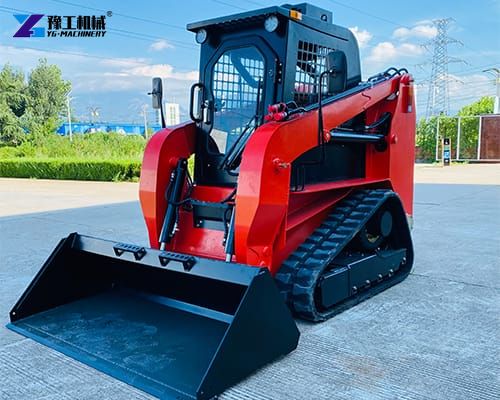
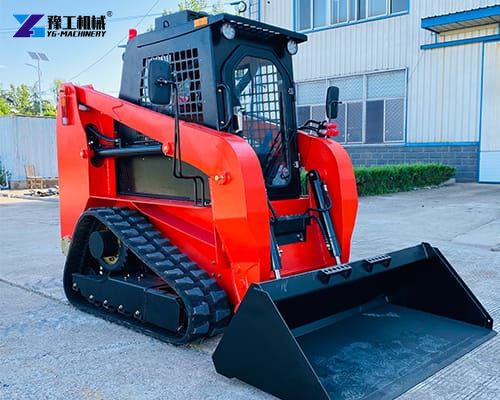
Features of Compact Crawler Skid Steer Loader
- Compact Yet Powerful
Although relatively small compared with large wheel loaders, these machines deliver remarkable breakout force and lifting capability. Their compact footprint allows access to narrow workspaces without sacrificing productivity. - Rubber Track System
The track system significantly improves grip compared with tires. Operators can maintain better control while working on muddy, snowy, or rocky terrain. - Quick Attachment Coupler
One machine can perform dozens of different tasks simply by changing attachments. - Hydraulic Performance
Modern hydraulic systems provide smooth movement, rapid cycle times, and consistent power delivery for demanding attachments. - Operator Comfort
Many manufacturers equip enclosed cabs with air conditioning, suspension seats, ergonomic controls, touchscreen displays, and reduced noise levels. - Durability
Heavy-duty steel frames, reinforced loader arms, protected hydraulic lines, and wear-resistant components ensure long service life under harsh operating conditions.
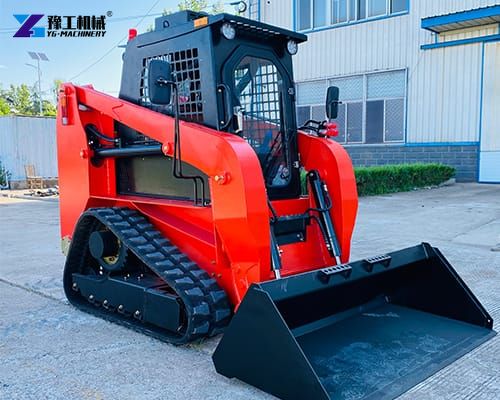
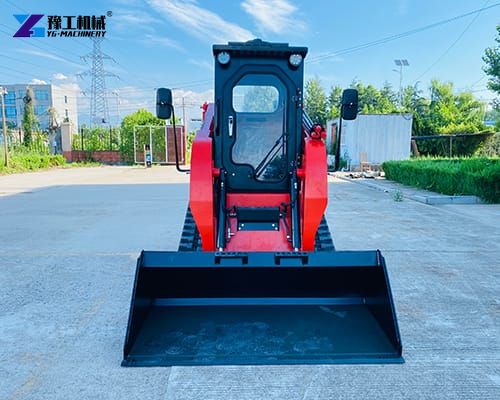
Structure and Main Components
- Main Frame
The reinforced chassis supports the entire skid steer track loader while absorbing heavy working loads. - Engine
The diesel engine provides power for both travel and hydraulic systems. - Hydraulic System
Hydraulic pumps, valves, cylinders, hoses, and motors convert engine power into lifting, tilting, steering, and attachment operation. - Track Assembly
Rubber tracks, drive sprockets, rollers, idlers, and tensioning systems ensure stable movement across different surfaces. - Loader Arms
Heavy-duty lift arms raise and lower the attachment with excellent stability. - Bucket
The bucket remains the most commonly used attachment for digging, loading, grading, and transporting loose materials. - Cab
The operator station integrates controls, display systems, safety devices, and visibility enhancements.